To protect your service business from embezzlement you MUST: stay involved in your business’s finances, separate accounting duties, and use accounting software with strong security and audit trails.
If you own or manage an HVAC, plumbing, electrical, or construction business and would rather be running calls than dealing with accounting software, you are not alone. I know most service business owners didn’t get into this industry because they love bookkeeping. Unfortunately, that mindset is exactly what dishonest employees rely on.
Embezzlement is one of the most common criminal reasons small service businesses fail, and it almost never looks obvious at first. I’ve spent decades consulting with contractors, and I’ve heard hundreds of painful stories involving trusted bookkeepers, long-time employees, business partners, and even close friends. There is no “type” of person who steals. The common denominator is opportunity.
The good news is this: most theft is preventable. You don’t need to become an accountant, but you do need to understand the basics, stay involved, and set up your systems correctly. In this article, I’ll walk you through the most common embezzlement schemes and the practical controls that stop them cold.
💡 Pro Tip: Take One Week a Year and Personally Do the Bookkeeper’s Job
Once per year, take a full week to personally review bank statements, deposits, invoices, payroll reports, and audit trails as if you were the bookkeeper. You do not need to process transactions, just follow the money. Knowing that the owner periodically steps into the process is one of the strongest deterrents against theft and often reveals weak spots that normal routines hide.
Key Takeaways
Embezzlement thrives when owners disengage from financial oversight
There is no “type” of employee who steals and trust is not a control
Strong accounting controls and audit trails are your first line of defense
No single employee should control an entire financial process
Most theft can be prevented with basic procedures and owner involvement
Common Embezzlement Tactics in Service Businesses
Most embezzlement isn’t sophisticated or dramatic; it’s repetitive, quiet, and designed to blend in with normal daily activity. These schemes work because they exploit routine, trust, and a lack of oversight. Understanding how theft actually happens in real service businesses is the first step toward preventing it. Keep a look out for the following things.
The Fake Vendor
A dishonest bookkeeper creates a vendor name that looks almost identical to a real one; think “Carrier Inc.” instead of “Carrier.” Payments are made to this fake vendor, which is actually a bank account controlled by the thief. Subtle name differences are easy to miss if you’re not reviewing checks and bills carefully.
The Fake Employee
This scheme involves setting up a non-existent employee in payroll and issuing paychecks, bonuses, or reimbursements. It’s more common in larger companies, but it can happen anywhere payroll oversight is weak.
Altered Checks
In older (and still surprisingly common) setups, checks are typed and signed. The criminal later alters the “Pay To” field after the signature. While modern accounting systems reduce this risk, it still happens when controls are lax.
Bookkeeper–Technician Collusion
This is one of the most damaging scenarios. A technician collects payment, a bookkeeper deletes or alters the invoice, and the money never makes it into your system. Cash payments make this dramatically easier which is another reason to discourage cash whenever possible.
“Less Cash” Deposits
A bookkeeper deposits company checks but withdraws cash at the same time, pocketing the difference. This should never be allowed. Checks endorsed “For Deposit Only” must go directly into the company account with no cash back, no exceptions.
💡 Pro Tip: Look for Lifestyle Changes Amongst Your Associates, Not Just Bad Math
One of the earliest warning signs of embezzlement has nothing to do with your books. Pay attention to sudden lifestyle changes, such as expensive purchases, frequent vacations, or unexplained cash spending that do not align with an employee’s pay. This does not mean you accuse anyone, but it does mean you increase oversight, review audit trails more frequently, and tighten permissions. Fraud is often uncovered by noticing patterns, not errors.
Financial Security Policies Every Owner Should Enforce
Strong financial controls aren’t about mistrusting employees; they’re about protecting the business you worked hard to build. The policies below create clear accountability, limit access to money, and make dishonest behavior easier to detect and harder to hide without slowing down your operation.
Bookkeeping Controls
These controls limit who can touch your money, create clear checks and balances, and make financial manipulation far more difficult to conceal.
Core Principles of Internal Control
Segregate Duties Ruthlessly. This is the cornerstone. No single person should control all parts of a financial transaction. Specifically:
Your bookkeeper must never sign checks.
The person who reconciles the bank and credit card statements must not be the bookkeeper.
If possible, keep payroll separate from the bookkeeping function.
Control the Cash.
Bank Access: Your bookkeeper may be granted “inquiry only” bank access to see transactions. They must never have transfer or withdrawal privileges.
Bank Mail: Have all bank correspondence, especially statements, sent to your home address, not the office. Open them yourself. This simple step can stop most fraud in its tracks.
Process: Have your bookkeeper review bills, prepare checks, and present them to you twice monthly for signing.
Your Review: Before you sign, carefully examine each check and its supporting bill. Match the bill to its original Purchase Order (PO). Look for irregularities or duplicate charges. A common fraud is submitting fake bills for supplies or repairs.
Your Signature: Use a unique signature style for checks, different from your everyday one. Consider a subtle, known-only-to-you mark. This helps you later verify the signature on canceled checks.
Examine Canceled Checks: When reviewing your bank statement, scrutinize each canceled check. Look for forged signatures, altered “Pay To” fields, and examine the endorsement on the back. Is it consistent with that vendor’s normal endorsement?
The Purchase Order System
Mandate POs: Implement a strict rule: Nothing is bought without a completed Purchase Order and an assigned PO number. This creates a mandatory paper trail for every expenditure.
Software & Audit Trails
Your accounting and credit card processing software are critical control points.
Audit Trails: In any software, turn the audit trail ON. A proper audit trail cannot be deactivated by anyone, not even an administrator, and must store tens of thousands of transactions. Review this monthly for deleted or voided items.
Administrative Rights: The business owner must be the sole holder of full administrative rights. This prevents the audit trail from being deleted and account numbers from being changed.
Deletion Rights: Do not grant anyone the ability to DELETE transactions. In proper systems, you can only “void” or “reverse,” which leaves an audit trail.
Credit Card Software: Understand your credit card deposit settings. It is not difficult for a dishonest employee to route charges into an account you don’t control. Ensure you alone control the administrative settings.
📝 Note: If you use Aptora 360, the audit trail cannot be turned off, permissions are granular, and deletion controls are built in for this exact reason.
Additional Vital Safeguards
Background Checks: Perform them on all employees.
Confidentiality Agreements: Have key employees sign them. They protect you and your clients.
Prosecute: Commit to prosecuting thieves. It’s a disservice to the honest community not to.
Outside Audit: If you have business partners, engage an independent auditing firm for an annual audit. It provides objective peace of mind for all parties.
Message Reconciliation: Have your answering service fax/email a log of all after-hours calls. Match these calls and all deposits against your invoices.
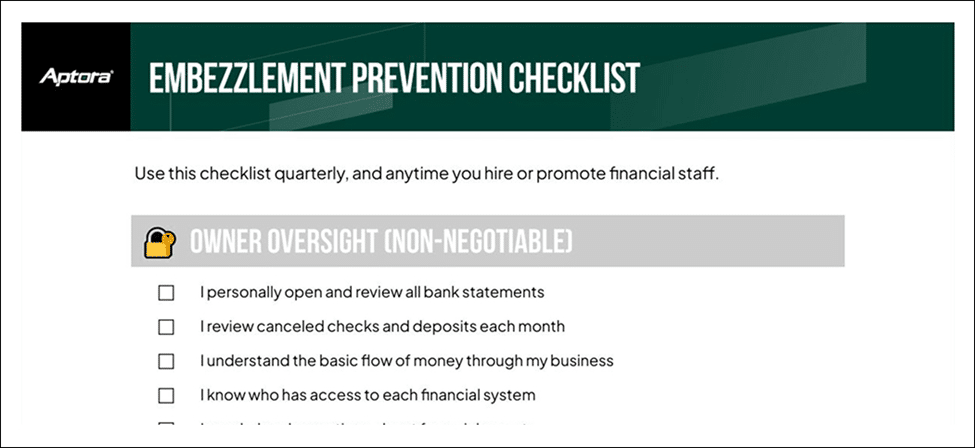
Embezzlement Prevention Checklist
📥 Don’t rely on memory. Download our Embezzlement Prevention Checklist for small business owners to quickly identify gaps in your financial controls and protect your company before problems start!
The right hiring practices and clear consequences send a strong message that honesty is expected, monitored, and enforced. For that reason, you should always:
Perform background checks on all employees
Require confidentiality agreements for key staff
Prosecute theft when it occurs (this protects you and others)
If you have partners, hire an outside firm to conduct annual audits
Physical and Data Security
Your company data is just as valuable as your cash, which is why securing your servers, backups, and company files is essential for protecting against theft, sabotage, and data loss while ensuring that one bad actor or one bad day does not cripple your business. To protect it, you should:
Store your company file on a secured server
Lock the server in a fire-resistant room or cabinet
Restrict physical access to the server
Perform nightly backups
Store at least one backup offsite weekly
Use fire-resistant storage for backup devices
Failure to protect customer and employee data can expose you to serious legal liability, not just financial loss.
Running a service business is hard enough without discovering that someone you trusted has been quietly draining your bank account. So, stay involved in your financial systems. Doing so doesn’t make you paranoid or distrusting, it makes you professional.
You don’t need to be an accountant, and you don’t need to do the bookkeeping yourself. But you do need to understand how your money flows, how your accounting software works, and where the risks live. Owners who stay involved, even at a high level, are far less likely to be victims of theft.
FAQs
1. How often should I review my accounting reports as an owner?
At minimum, monthly. Weekly is even better. Focus on bank reconciliations, audit trails, and exception reports.
2. Is insurance enough to protect me from embezzlement losses?
No. Crime insurance may cover some losses, but it won’t protect your cash flow, reputation, or relationships.
3. Should I trust long-term employees with fewer controls?
Absolutely not. Controls protect honest employees as much as they protect you.
4. What’s the single biggest red flag of potential embezzlement?
Resistance to oversight. If someone doesn’t want you reviewing reports or audit trails, pay attention.
5. Can small businesses really afford strong internal controls?
They can’t afford not to. Most controls cost nothing but attention and consistency.
Share:
Facebook
Twitter
Pinterest
LinkedIn
James R. Leichter
James R. Leichter, renowned HVAC business consultant, author, and public speaker, is dedicated to empowering HVAC businesses with innovative strategies and insights. Leichter, affectionately known as 'Mr. HVAC,' brings over 27 years of industry expertise and a passion for practical solutions, assisting HVAC businesses to streamline operations and maximize profits. Discover transformative guidance at MrHVAC.com.
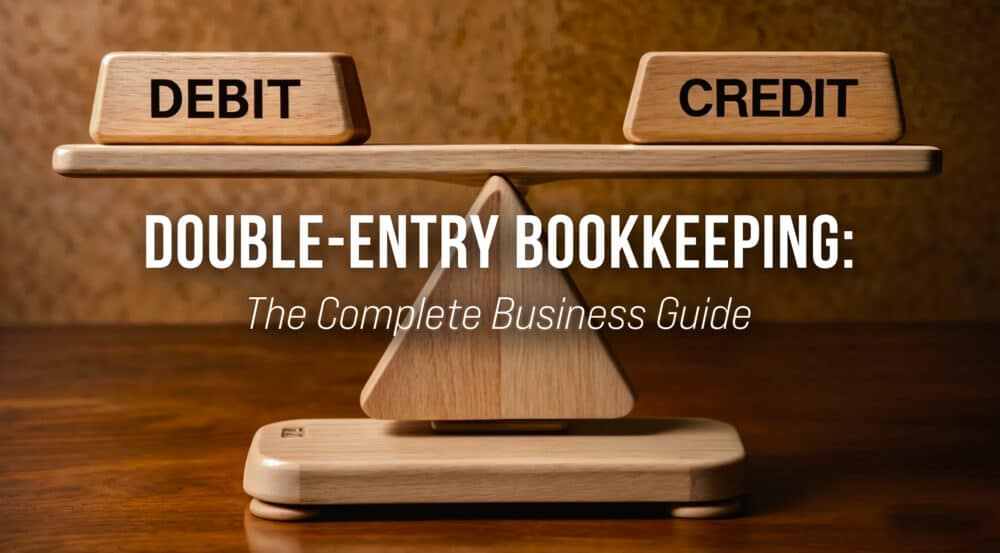
Quick Answer Double-entry bookkeeping is an accounting system that records every business transaction in at least two accounts, ensuring total debits always equal total credits.