In virtually all standard bookkeeping and accounting frameworks, land is classified as a non-current asset, specifically as a fixed asset or property, plant, and equipment (PP&E), NOT a current asset.
I know when you’re running a field service business, your mind is on the next call, the technician in the field, and the supplier invoice due tomorrow. The last thing you’re pondering is the abstract accounting classification of the dirt under your building. I get it.
Though, throughout my many years in this industry, I’ve seen brilliant technicians turned business owners’ eyes glaze over when talk turns to balance sheets. But here’s the hard truth that I’ve learned: confusion on your books can create major leaks in your profits.
And one of the most common, yet critical, points of confusion is this very question: Is land a current asset?
Understand that the answer to this question isn’t just a trivia fact for your CPA. It’s a fundamental concept that shapes how you understand your company’s financial health, its agility, and its true net worth. Misclassifying a major purchase like land can really distort your financial picture and lead to poor decisions about cash flow, lending, and your growth. Today, I want to pull back the curtain on this accounting principle, and show you why getting this right is just as important as having the right tools on your truck.
Key Takeaways
Land is never a current asset. In standard accounting, land is classified as a non-current, fixed, long-term asset under Property, Plant, and Equipment (PP&E).
Misclassifying land distorts your financial picture. Treating land like a current asset can mislead you, your lender, and potential buyers about your liquidity, working capital, and true financial health.
Land is an asset; the loan is the liability. If land feels like it’s “killing” your business, it’s usually the debt structure or cash flow strain (not the land itself) that is the problem.
Land is not depreciated. Ever. Unlike buildings or equipment, land has an indefinite useful life and must be excluded from depreciation calculations.
Land purchases reshape liquidity, not wealth. When cash is converted into land, your current assets drop, but your long-term equity may improve. Understanding that shift prevents panic and poor decisions.
Accurate allocation matters. When purchasing property with land and buildings, costs must be properly split. Only the building portion is depreciated.
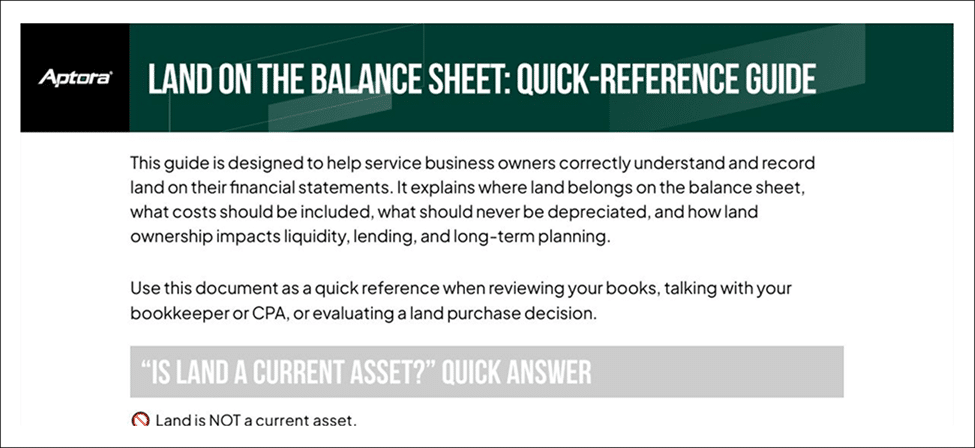
📥 Free Download: Confused about where land belongs on your balance sheet? Download our Land on the Balance Sheet: Quick-Reference Guide so you’ll know exactly how land should be recorded, valued, and handled on your books.
Understanding the Foundation: Assets, Liabilities, and Your Business Health
Before we dig into the specifics of land, we need a solid footing. Think of your balance sheet as a snapshot of your company’s financial position at a single moment in time.
On one side you have everything you own, which is your assets. On the other side you have everything you owe, your liabilities. And the difference between the two is your equity, the real value you’ve built.
The Critical Divide: Current vs. Fixed
Assets are further split into two crucial categories, and this is where the rubber meets the road for business operations.
Current Assets: These are the workhorses of your daily operations. They are cash or resources expected to be converted into cash or used up within one year or one business cycle. So, this includes your checking account, accounts receivable (the money your customers owe you), inventory of parts, and prepaid expenses like insurance. These are your liquid resources, the fuel for your cash flow engine.
Non-Current (Fixed) Assets: These are the long-term players. They are tangible, physical items you purchase for long-term use in producing income, not for resale. These assets are not easily converted into cash. This category includes assets like vehicles, machinery, office furniture, and, of course, buildings and… you guessed it… land on your balance sheet.
Why does this distinction matter so much? Lenders and savvy business owners look at your current assets (particularly in relation to your debts due within a year) to calculate your working capital and liquidity ratios, and those numbers tell an important story. They answer the question of: Can this business pay its short-term bills and is it agile?
Land, as you’ll see very shortly, doesn’t play in that short-term game.
The Nature of Land: A Permanent Fixture on Your Balance Sheet
Land is classified as a non-current, fixed, or long-term asset and sits firmly on the balance sheet under “Property, Plant, and Equipment” (often called PP&E).
The reasoning is rooted in both accounting principles and common sense, which I always prefer. A current asset must have an expectation of being converted into cash within a year. When you purchase a parcel of land for your new headquarters or a storage yard, what’s your intent? You almost certainly aren’t buying it with the plan to flip it in 12 months. You’re buying it to use, to operate from, store equipment on, or build equity in for many years to come. It’s a strategic, long-term investment in your business’s infrastructure.
This leads directly to another common query: Is land an asset or a liability? The answer to that question is that it is unequivocally an asset. It has economic value that provides a future benefit to your company. However, and this is a BIG however, the financing of that land can create a liability (a mortgage).
The land itself is an asset; the loan you took to buy it is a liability. This separation is vital for clear thinking. I’ve sat with too many owners who point to their mortgage payment and say, “This land is killing me.” No, the land is providing a permanent home for your business. The debt structure you used to acquire it is the financial drag. This is a crucial distinction.
The Depreciation Dilemma: Why Land Stands Alone
Now we arrive at one of the most misunderstood areas in small business accounting. Ask any group of contractors, “Is land a depreciable asset?” and you’ll get a mix of confident yeses and nos.
Now, here’s the clear rule: Land is not depreciated.Ever.
Here’s the logic, straight from the IRS Publication 946: depreciation is an annual tax deduction that allows you to recover the cost of a business asset that wears out, decays, or loses its value over time. A building’s roof leaks, its HVAC system fails, its interior becomes outdated. It has a determinable useful life. Land, however, is considered to have an indefinite useful life. It doesn’t wear out, become obsolete, or get used up. That plot you own (barring a natural disaster) will still be there in 100 years.
This becomes critically important when you purchase a property that includes both land and buildings. The cost must be allocated between the two. Only the building’s portion is depreciated over 39 years (for commercial property). Getting this allocation wrong is a common and costly error. If you over-allocate value to the building, you’re taking depreciation deductions you aren’t entitled to, which can lead to problems during an IRS audit. My team at RA Tax and Accounting sees this often during business valuations and tax prep. A proper appraisal or tax assessor’s breakdown is essential here.
Real-World Implications for Field Service Companies
Theory is fine, but how does this play out in the real, gritty world of service vans and on-call rotations? Let me give you two scenarios.
Example 1: The Growing HVAC Contractor
“ClimateGuard Heating & Cooling” has outgrown its rented warehouse. The owner, Maria, finds a perfect 2-acre lot to buy and build a new facility. She uses $150,000 from company savings for the down payment and finances the rest.
On her balance sheet, that $150,000 (and eventually the full purchase price) moves from “Cash” (a current asset) to “Land” (a fixed asset). Her current assets drop significantly on paper. If she doesn’t understand this, she might panic, thinking her liquidity has vanished. Whereas, in reality, her wealth has been transformed from liquid cash to a solid, long-term equity position.
Her cash flow for operations, however, must now be managed more carefully, as a large chunk of liquid capital is now tied up.
💡 Pro Tip: Stress-Test Your Cash Flow Before You Buy Land
Before purchasing land, model your cash flow as if the down payment and debt service already exist. If operations feel tight on paper, they will feel tighter in real life. Land can be a powerful long-term asset, but only when it doesn’t choke the cash flow that keeps trucks rolling and payroll funded.
Example 2: The Electrical Contractor Seeking a Loan
“SparkRight Electrical” wants a $100,000 line of credit to purchase a new fleet of bucket trucks. The bank scrutinizes their balance sheet. They see SparkRight has $500,000 in “Property, Plant, & Equipment,” mostly in land and a building.
The bank appreciates this equity but doesn’t count it toward short-term liquidity. They focus on the current ratio: Current Assets / Current Liabilities. If SparkRight’s current assets are low because they recently bought that land, their ratio may look weak, making the loan harder to secure.
To remedy this, the owner needs to explain this strategic move and perhaps show projections of receivables coming in.
How to Record Land in Your Bookkeeping
Correctly recording a land purchase is crucial. It’s not an expense that hits your profit and loss statement (P&L) all at once. Instead, it’s capitalized on the balance sheet.
Recording Land in Your Bookkeeping: What to Include When you purchase a plot of land for your business, you record it at its historical cost. This includes the purchase price plus all costs to get it ready for its intended use: closing costs, legal fees, title insurance, and costs for clearing, grading, or surveying. If you take out a loan to buy it, only the asset cost is recorded; the loan is a separate liability.
💡 Pro Tip: Separate “Accounting Value” From “Decision Value”
Your balance sheet records land at historical cost, but that number should not be the one you rely on for strategic decisions. Keep a separate internal note of the estimated market value of your land for planning purposes like refinancing, expansion, or exit strategy. Just don’t mix that number into your books. Smart owners track both the accounting truth as well as the business reality.
📝 Note: If you’re using accounting software, make sure it allows you to clearly separate land from buildings, lock down permissions, and maintain a permanent audit trail. Software like Aptora 360 are designed specifically for service businesses and make this kind of control much easier to maintain.
Understand What Land Really Means to Your Business
So, all in all, is land a current asset? No. It is a fixed, long-term, non-depreciable asset that represents a permanent investment in your business’s foundation. Understanding this isn’t about passing an accounting exam; it’s about wielding financial clarity as a competitive tool. It empowers you to make smarter decisions about debt, growth, and your company’s valuation.
Don’t let your balance sheet be a mystery to you. Treat it with the same respect as you would treat your technical manuals. Know what each line means for your daily reality and your legacy. When you truly understand the role of every asset, from the cash in your drawer to the land under your feet, you transition from being a technician who owns a job to a CEO who owns a future. And that is the most valuable asset of all.
FAQs
1. What if I plan to sell the land within a year, does that make it a current asset?
No. Intent alone does not change the classification. Unless your business is in the business of buying and selling real estate, land is still recorded as a non-current asset. Even if you hope to sell it soon, accounting classification is based on the nature of the asset, not your short-term plans.
2. Can land ever show up on my profit and loss statement (P&L)?
Not directly. Land lives on the balance sheet. The only time it affects the P&L is when it’s sold, at which point you recognize a gain or loss based on the difference between the sale price and its book value.
3. Does land count as collateral when applying for loans?
Yes, and lenders like it. While land doesn’t help your short-term liquidity ratios, it often strengthens your balance sheet and can be used as collateral for long-term financing or expansion loans.
4. Should land be held inside the operating company or in a separate entity?
That depends on your risk tolerance and long-term strategy. Many owners choose to hold land in a separate LLC and lease it back to the operating business to reduce liability exposure and improve flexibility. This is a legal and tax decision that should be made with professional guidance.
5. How often should the value of land be updated on the books?
Almost never. Land is recorded at historical cost and is not revalued for market changes under standard accounting rules. Increases in market value matter for financing, insurance, or sale decisions; but, they don’t change the number on your balance sheet.
Share:
Facebook
Twitter
Pinterest
LinkedIn
James R. Leichter
James R. Leichter, renowned HVAC business consultant, author, and public speaker, is dedicated to empowering HVAC businesses with innovative strategies and insights. Leichter, affectionately known as 'Mr. HVAC,' brings over 27 years of industry expertise and a passion for practical solutions, assisting HVAC businesses to streamline operations and maximize profits. Discover transformative guidance at MrHVAC.com.
Do you have money you need to spend before December 31st? If you’re planning to purchase equipment, vehicles, or software for your contracting business, Section