Beginning Balances and Ending Balances for Beginners

Defining Beginning and/or Ending Balances The beginning balance represents the amount in an account at the start of a period, such as a fiscal year


What are undeposited funds, and why are they on your balance sheet? Here is a quick answer to that question and a more detailed explanation.
Undeposited funds are not a separate bank account. They represent money your business has received but has not yet deposited into the appropriate bank account. Once you record the deposit, your accounting records move the balance from Undeposited Funds to the designated bank account.
QuickBooks from Intuit and Total Office Manager from Aptora use the concept of Undeposited Funds. Other accounting and ERP software programs do the same thing. These systems use Undeposited Funds as a special temporary account to hold customer payments until you record the corresponding bank deposit.
Undeposited funds appear on the balance sheet because they represent an asset your company has received but has not yet recorded in its bank account. The balance sheet shows this amount as part of your company’s assets.
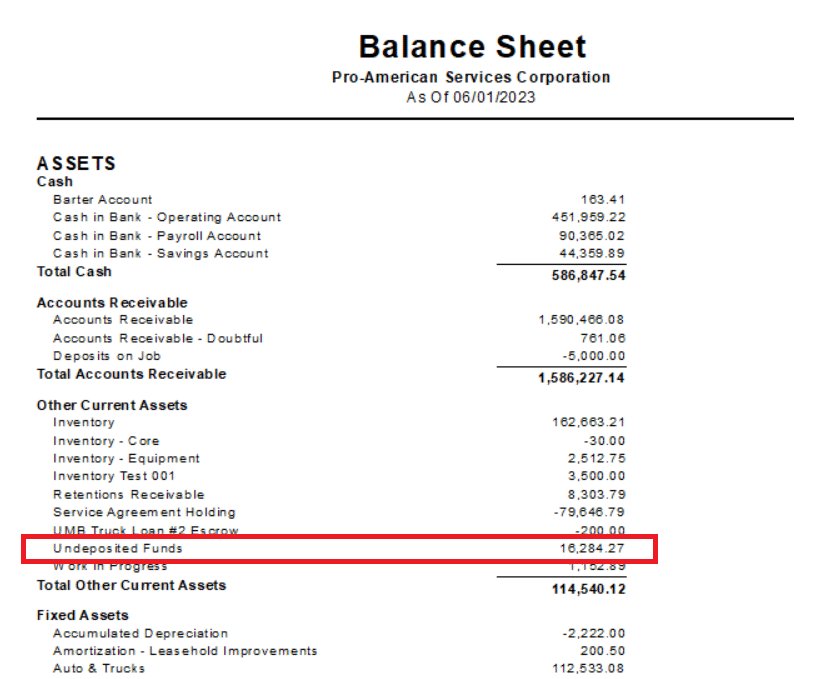
For more background on how assets are organized and reported, see Aptora’s guide to double-entry bookkeeping.
Use the Undeposited Funds account to hold customer payments you want to combine before recording a bank deposit. It’s like the lockbox or drawer where you keep payments before taking them to the bank. This two-step process helps your accounting records match your bank records and makes bank reconciliations easier.
When you put money in the bank, you often deposit several payments at once. For example, let’s say you deposit five $100 checks from different customers into your checking account. Your bank records all five checks as one $500 deposit.
To make your accounting records match the bank statement, you need to combine the five separate $100 payments into one $500 deposit in your books.
The Undeposited Funds account provides a way to track each payment individually before recording the combined deposit.
Undeposited funds represent payments that have been received but have not yet been recorded as deposited into the bank. This can include cash, checks, and other customer payments, depending on how your business processes and records them.
If the Undeposited Funds balance on your balance sheet seems unusually high, review the payments that make up that amount. Determine whether the payments are awaiting deposit, you deposited them without recording the deposits correctly, or someone entered them more than once.
Compare your payment records with your bank deposit records to identify discrepancies. Regular bank reconciliations can help you find missing transactions, duplicate entries, and deposits that your accounting records don’t accurately reflect.
If you already deposited a payment but it still appears in Undeposited Funds, you may need to correct your accounting records. Review the original transaction and the corresponding bank deposit before making changes. Simply moving the balance to a bank account without verifying what happened could create duplicate deposits or distort your financial statements.
If the discrepancy affects a closed accounting period or a tax return you’ve already filed, consult your accountant before changing the records.

Defining Beginning and/or Ending Balances The beginning balance represents the amount in an account at the start of a period, such as a fiscal year
What Are Undeposited Funds? What are undeposited funds, and why are they on your balance sheet? Here is a quick answer to that question and
How to Number Your Chart of Accounts (COA) A standard chart of accounts (or COA) is organized according to a numerical system. The chart of
An Accounts Receivable (A/R) Aging Summary Report shows, in a condensed way, the amount of money owed to your business by customers, along with how