Vendor Types List: Which Categories Fit Your Suppliers?

The Vendor Types List is used to manage and classify the various suppliers (vendors) from which you buy goods and services. Examples of vendor types


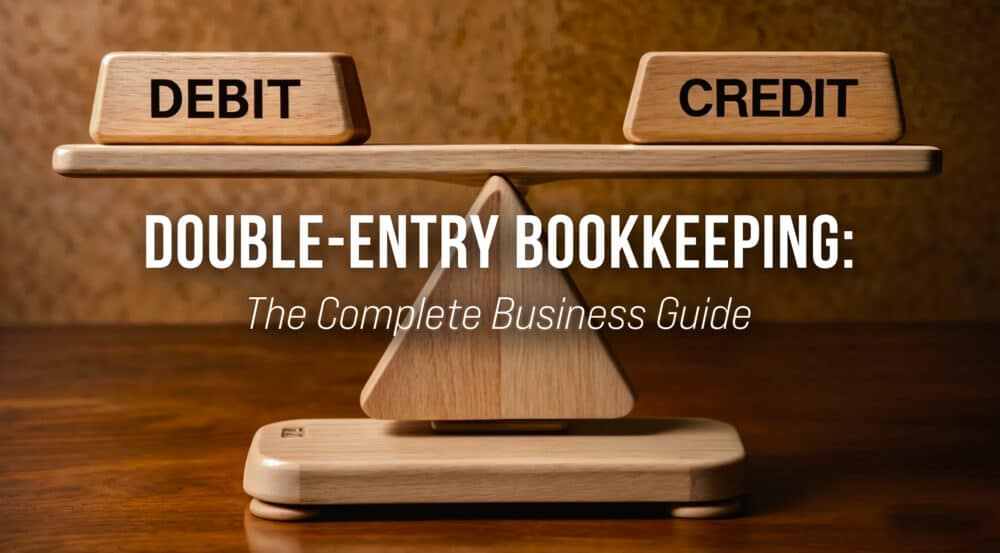
Double-entry bookkeeping is an accounting system that records every business transaction in at least two accounts, ensuring total debits always equal total credits. This approach keeps financial records balanced and provides a clearer picture of a business’s assets, liabilities, revenue, and expenses.
I once had an HVAC contractor running six trucks hand me a shoebox of receipts and ask, “James, did I make any money last year?” Despite having plenty of customers, his books couldn’t tell him which jobs were profitable, what he owed, or whether he could afford another technician.
The problem here obviously wasn’t his trade skills. It was his bookkeeping, specifically the fact that he had never embraced double-entry bookkeeping.
This article is my attempt to pull back the curtain on double-entry bookkeeping, not as a dry academic concept, but as the practical, profit-protecting tool it was always meant to be. Let’s dive in!
📥 Want to put these concepts into practice? Download our FREE Double-Entry Bookkeeping Guide for Contractors for practical worksheets, examples, and bookkeeping checklists.

The simplest definition of double-entry bookkeeping is this:
Every financial transaction affects at least two accounts, and the total amount debited must equal the total amount credited.
The IRS describes a double-entry system as one that uses journals and ledgers to track income, expenses, assets, liabilities, and net worth. It also points to one of the system’s built-in checks: once transactions are posted, total debits must equal total credits. You can find more on this explanation in IRS Publication 583, Starting a Business and Keeping Records.
Let’s look at a simple example of this principle. Suppose your business buys a $5,000 piece of equipment with cash. The journal entry would look like this:
Account                     | Debit ($) | Credit ($)
----------------------------|-----------|------------
Equipment                   | 5,000     |
Cash                        |           | 5,000
As you can see, two things happened in this transaction:
In other words, your business exchanged one asset for another and the journal entry records both financial effects, rather than simply recording that $5,000 left your checking account.
That is the idea behind double-entry bookkeeping. Every transaction is recorded in a way that shows what changed on both sides of the accounting equation.
Understanding that every transaction touches two accounts, should get you to start seeing your business differently. You should stop thinking in terms of “money in, money out” and start thinking in terms of assets, liabilities, equity, revenue, and expenses.
One way to understand double-entry bookkeeping is to compare it with the simpler system it replaces: single-entry bookkeeping.
Single-entry bookkeeping is much closer to maintaining a check register. You record the money coming into the business and the money going out, giving you a running picture of your cash activity.
For example, a very simple record might look like this:
| Date | Description | Money In | Money Out |
| May 1 | Service Call | $750 | |
| May 2 | Fuel | $110 | |
| May 3 | Materials | $325 |
For a very small operation with relatively few transactions, this approach can be straightforward. You can see what came in, what went out, and, assuming you’ve recorded everything, roughly how much cash remains.
The problem is that cash activity is only one part of what is happening in a business.
Imagine that same service company completes a $2,000 job today but won’t collect the customer’s payment for another 30 days. Or it receives a $1,000 customer deposit for work that hasn’t been performed yet. It might purchase equipment using a credit card, leaving the business with both an asset and a liability. It might owe employees payroll taxes that have not yet been remitted.
None of those situations can be fully explained by simply looking at “money in” and “money out”.
As a business becomes more complex, you need to keep track not only of cash, but also of what the business owns, what it owes, what customers owe it, and what portion of the business belongs to the owner.
That is where double-entry bookkeeping becomes important.
The IRS describes single-entry bookkeeping as a system that may be suitable for some small businesses, while double-entry bookkeeping provides a more thorough system of checks and balances by recording both sides of a transaction.
With double-entry, the books can keep track of things such as:
The important distinction is not that single-entry bookkeeping is somehow “wrong.” It is that single-entry primarily follows individual cash transactions, while double-entry captures the broader financial relationships created by those transactions.
A real business has more going on than deposits and withdrawals. Double-entry bookkeeping gives you a way to record those interconnected changes while keeping the books in balance.
That is also why the accounting equation you’ll see next is so important. It is not just a formula to memorize. It is the underlying relationship that double-entry bookkeeping keeps intact as transactions are recorded.
At the heart of double-entry is something called the accounting equation, which is:

This equation is the bedrock of the entire system. Every transaction you record must keep this equation in balance.
If you buy a truck with a loan, your assets increase (the truck) and your liabilities increase (the loan). The equation stays balanced.
If you pay off that loan with cash, your assets decrease (cash) and your liabilities decrease (the loan). Still balanced.
Why does this matter for a field service business? Because the accounting equation is a built-in error detection system. If your books don’t balance, you know something is wrong, and you can trace the problem back to a specific entry. Without double-entry, errors can hide in plain sight. With it, they surface immediately. I’ve seen contractors who ran their entire business on a single-entry spreadsheet for years. They thought they were saving time, when in reality, they were quietly accumulating a mountain of errors that would eventually cost them far more than a proper bookkeeping system ever would have.
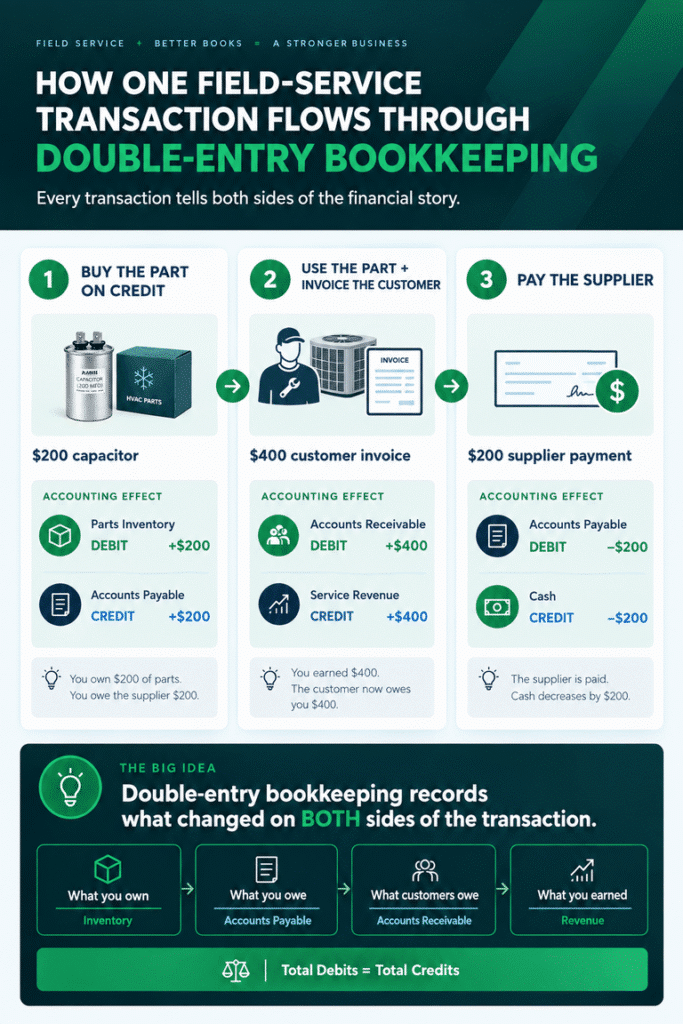
The accounting equation explains why double-entry bookkeeping works. But, seeing the equation in action is a much better way to understand how it works in a real business. So, let’s walk through some journal entries for a simple field service transaction from the moment you purchase a part to the moment the customer pays for the work.
You send a tech to a job with a $200 capacitor. You bought that capacitor from a supplier on credit. Here’s how double-entry handles it:
Account                     | Debit ($) | Credit ($)
----------------------------|-----------|------------
Parts Inventory             | 200       |
Accounts Payable            |           | 200
The business now has $200 worth of parts, but it also owes the supplier $200.
Next, when the tech uses the capacitor on a job and you invoice the customer $400, the transaction is recorded as:
Account                     | Debit ($) | Credit ($)
----------------------------|-----------|------------
Accounts Receivables        | 400       |
Service Revenue             |           | 400
Now the business has earned $400 in revenue and has a $400 receivable from the customer.
And finally, when you pay the supplier the $200 you owe:
Account                     | Debit ($) | Credit ($)
----------------------------|-----------|------------
Accounts Payable            | 200       |
Cash                        |           | 200
As you can see, every step is tracked. You know exactly what you own, what you owe, what you earned, and what you spent. THIS is the power of double-entry bookkeeping. It turns a chaotic pile of transactions into a coherent financial narrative. I’ve seen field service companies that skip this level of detail and wonder why their job costing is always off. They can’t tell which jobs are profitable because they never tracked the full cost of the parts and labor that went into them, and double-entry fixes that.
You’ve just seen how transactions can be recorded in a journal entry. Now let’s shine a little light on what’s actually happening inside those entries.
This is the part of bookkeeping that often sounds more complicated than it really is. The words debit and credit can feel confusing because they don’t always mean what you might expect from everyday banking.
In bookkeeping, the basic idea is simple:
Debit = left side
Credit = right side
That’s it.
Neither word automatically means good or bad, money received or money spent. A debit or credit simply tells you which side of an account is being recorded. Whether it increases or decreases the account depends on the type of account involved.
The table below shows the basic relationship:
| Account Type | Increase | Decrease | Normal Balance |
| Assets | Debit | Credit | Debit |
| Expenses | Debit | Credit | Debit |
| Liabilities | Credit | Debit | Credit |
| Equity | Credit | Debit | Credit |
| Revenue | Credit | Debit | Credit |
For example:
Once you understand this pattern, debits and credits become much less mysterious. Again, the key is to stop thinking of them as inherently meaning “money in” or “money out” and instead think about what type of account is changing and whether it is increasing or decreasing.
Some accounting students use the mnemonic DEALER:
Draws/distributions
Expenses
Assets
normally increase with Debits.
Liabilities
Equity
Revenue
normally increase with Credits.
You, of course, don’t have to memorize this trick forever. As you work through transactions, the relationships between account types, increases, and decreases will start to make sense on their own.
When looking at a transaction, beginners often ask the wrong question first:
Is this a debit or a credit?
Instead, work through the transaction in this order:
That sequence gives you a logical way to arrive at the answer instead of trying to memorize whether a particular transaction “sounds like” a debit or credit. It also connects directly back to the accounting equation: every transaction changes accounts in a way that keeps the equation in balance.
Understanding double-entry bookkeeping is one thing. Building a system that actually works for a business is another.
If you’re setting up your books from scratch, it can be tempting to jump straight into entering transactions and creating journal entries. But, the journal entry is really the end of a process, not the place where that process should begin.
Before you start recording transactions, you need to establish the structure that those transactions will flow through. That means deciding which accounts you need, what their starting balances are, how transactions will be handled, and how you’ll make sure the information stays accurate over time.
Here’s what that process generally looks like.
The first piece of the structure is your chart of accounts. This is the organized list of accounts you use to classify the financial activity of the business.





Gain precise financial control with our industry-specific Chart of Accounts. This editable Excel blueprint provides pre-built categories and departmental tracking for HVAC, plumbing, and electrical, delivering the clarity needed to track profitability and drive smarter business decisions.
The goal isn’t to create as many accounts as possible. It’s to create enough detail to understand how the business is performing without making the books unnecessarily complicated.
A smaller company might begin with:
| Account Type | Accounts |
| Assets | Checking |
| Accounts Receivable | |
| Inventory | |
| Vehicles | |
| Equipment | |
| Liabilities | Accounts Payable |
| Credit Card | |
| Sales Tax Payable | |
| Payroll Liabilities | |
| Loans Payable | |
| Equity | Owner Contributions |
| Owner Distributions | |
| Retained Earnings | |
| Revenue | Service Revenue |
| Installation Revenue | |
| Other Operating Revenue | |
| Expenses | Materials |
| Subcontractors | |
| Wages | |
| Payroll Taxes | |
| Fuel | |
| Insurance | |
| Rent | |
| Advertising | |
| Office Expense |
As the business grows, you can add accounts when they provide useful reporting detail or serve a legitimate accounting purpose. The objective is a chart of accounts that helps you understand the business, not one that simply contains hundreds of categories because your software allows them.
Once you know which accounts you’ll be using, you need to establish where the business stands at the starting point of the new system.
If you’re starting a brand-new business, that may be relatively simple. If you’re moving from another accounting system, a spreadsheet, or a less formal bookkeeping process, it can be much more involved.
Your opening balances may include:
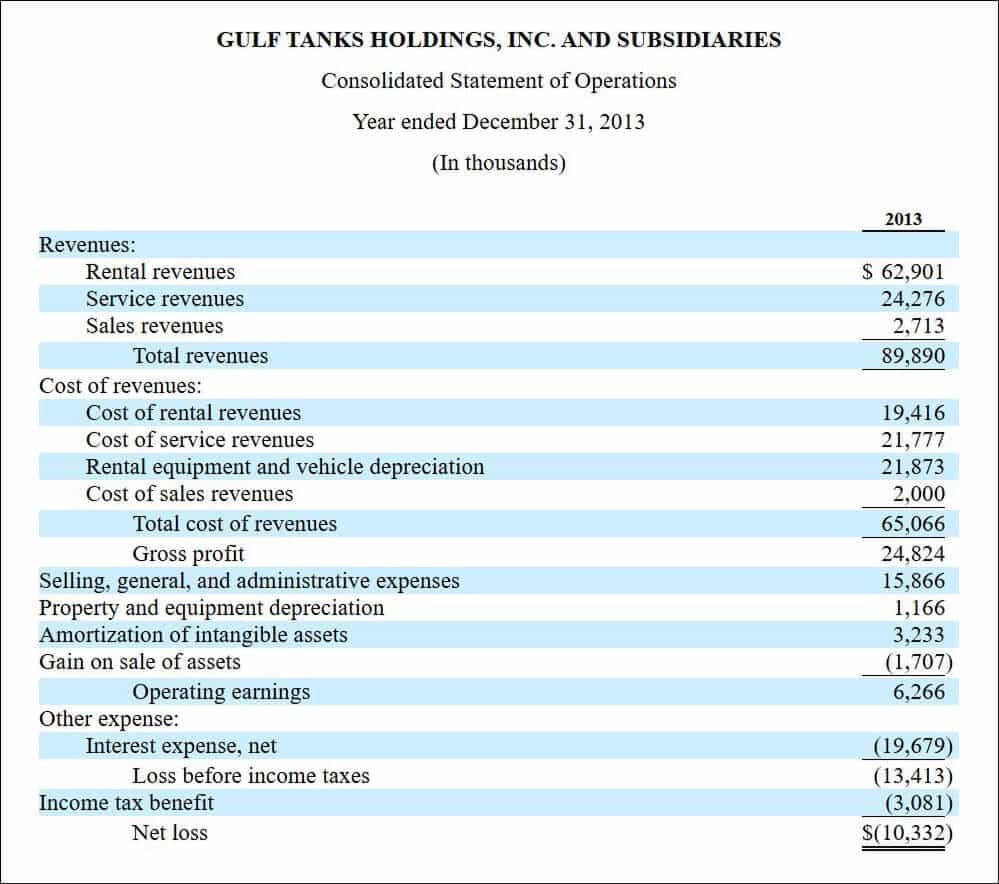
These balances become the foundation for everything that follows. So, if your opening balances are garbage, that problem doesn’t just stay isolated to that day. It carries forward into your financial statements and will in turn give you garbage reports.
In other words, take the time to get the starting point right. A clean set of opening balances makes the rest of the accounting system much easier to maintain.
With the structure and starting balances in place, the next question is how transactions will actually move through the system.
Accounting software can record transactions, but it can’t decide who should approve a bill, when an invoice should be issued, or who is responsible for reconciling the bank account. Those are business procedures.
For example, decide:
Clear procedures help prevent transactions from being missed, duplicated, or recorded incorrectly. They also make it easier to determine who is responsible for each part of the bookkeeping process.
Software can enforce a process, but it cannot create a well-designed process for you.
Once the structure and procedures are established, you can begin recording transactions according to those rules.
It is the IRS’ recommendation to maintain business records in a system that clearly shows income and expenses and identifies business transactions.
Consistency matters because bookkeeping is cumulative. Today’s transactions become tomorrow’s beginning balances, account totals, financial statements, and tax records.
A mistake that seems minor when it occurs can eventually affect:
That is why good bookkeeping isn’t simply about getting each individual transaction right. It’s about maintaining a reliable chain of financial information over time.
Recording transactions is only half the job. You also need to compare the balances in your accounting system with reliable outside records to make sure they agree.
That’s where reconciliation comes in.
Bank accounts are the obvious example. If your accounting system says you have $25,000 in the bank, you should be able to compare that balance with the bank’s records and explain any differences.
The same principle can apply to other important balance sheet accounts, such as credit cards, loans, accounts receivable, and accounts payable.
Regular reconciliation helps uncover missing transactions, duplicate entries, timing differences, and other errors while they’re still relatively easy to investigate.
Waiting until tax season to discover a bookkeeping problem can turn a small discrepancy into months of detective work. The more regularly you reconcile, the smaller the problems tend to be when you find them.
Finally, the purpose of all this recordkeeping is not simply to produce a set of reports.
It’s to help you understand what is happening in the business.
Once your books are structured properly, transactions are recorded consistently, and accounts are reconciled, your financial statements become much more useful. Instead of simply looking at the numbers, you can start asking what those numbers are telling you.
For example:
These questions move bookkeeping beyond recordkeeping and into financial management.
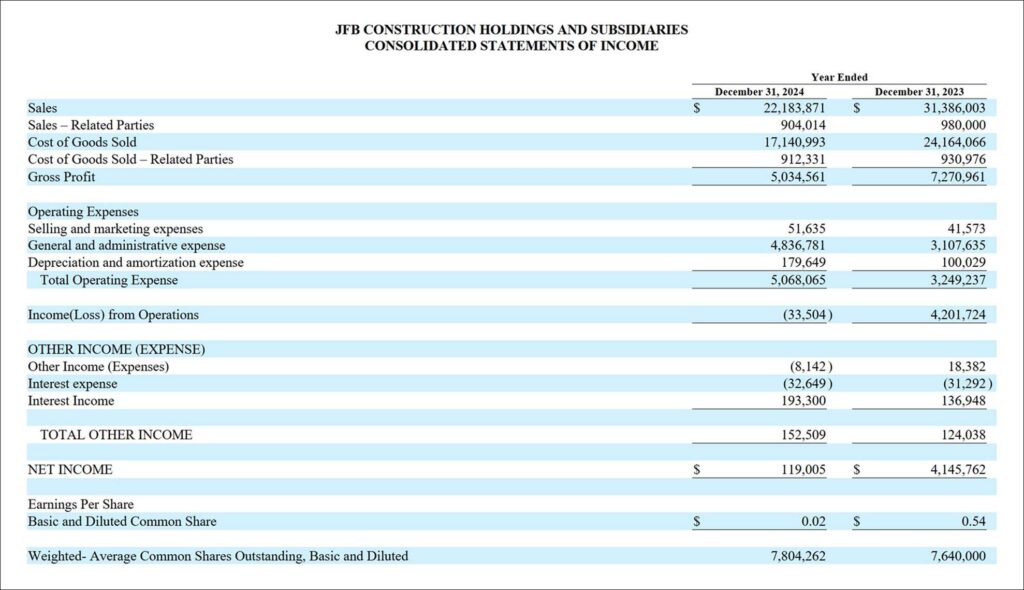
Good bookkeeping should do more than tell you what happened. It should help you ask better questions about what happened and what to do next.
One of the misconceptions about double-entry bookkeeping is that it means someone has to sit down and manually enter every debit and credit. While manual bookkeeping may have been the norm in the past, modern accounting software can automate much of that work.
Modern accounting software is built around double-entry principles. You may not see the debit and credit every time you create an invoice or receive a payment, but the accounting system is still making those entries behind the scenes.
For example, when you create a customer invoice, the software can record the increase in Accounts Receivable and the corresponding Service Revenue. When the customer pays, it can reduce Accounts Receivable and increase Cash or Undeposited Funds.
The same thing happens on the vendor side. Enter a properly configured vendor bill, and the system can record the appropriate expense, inventory, asset, or job cost while also increasing Accounts Payable.
That one entry can then flow into the vendor balance, job information, financial statements, and other parts of the system.
The accounting rules haven’t gone away. The software is simply applying those rules for you.
And that’s really what good automation is supposed to do. It shouldn’t replace the accounting system. It should make the accounting system easier to use, more consistent, and less dependent on someone remembering which side of the ledger needs to be updated.
This is where a contractor’s accounting needs start to look a little different from the accounting setup you might see in a generic small-business example.
A contractor doesn’t just need a general ledger sitting off to the side. You need the general ledger connected to the work that creates the numbers in the first place.
Think about everything that happens before a number eventually lands on a financial statement. An estimate becomes a job. A job generates purchase orders, material purchases, timecards, payroll, vendor bills, customer invoices, and payments. Those transactions affect job costs, receivables, payables, inventory, equipment, and ultimately the company’s financial results.
Ideally, those pieces should work together.
That can mean connecting your accounting system with:
The goal isn’t to have more software. The goal is to have fewer places where the numbers can get out of sync.
If technicians are working in one system, dispatch is using another, accounting is working in another, job costing lives in Excel, and the owner is looking at a separate dashboard, somebody has to keep all of those systems in agreement.
That usually means re-entering information, importing files, maintaining integrations, or chasing down differences when one system doesn’t match another.
I’ve never believed that adding more disconnected software automatically makes a contractor more sophisticated. Sometimes it just gives you more places for the truth to disagree with itself. That’s one reason an all-in-one integrated contractor management platform such as Aptora is valuable.
Instead of treating accounting as something that happens after the work is done, Aptora connects accounting with the operational side of the contracting business, including the jobs, customers, technicians, purchasing, inventory, and other activities that generate the financial data in the first place.
The best setup is the one where the information entered during the workday can flow through the business and eventually show up in the accounting records without someone having to rebuild the story by hand.
By this point, you’ve seen how double-entry bookkeeping is supposed to work. But there’s an important distinction to make: a set of books can be balanced and still be wrong.
The fact that your total debits equal your total credits only tells you that both sides of your entries agree. It does not guarantee that you used the right accounts, entered the right amount, or recorded the transaction correctly. That’s why understanding the mechanics of double-entry is just as important as making sure the numbers balance.
Here are some of the mistakes to watch for:
Every transaction needs two sides. If you buy a $5,000 piece of equipment with cash, for example, you need to record both the increase in Equipment and the decrease in Cash.
If you record only one side, your debits and credits will no longer balance. That makes this one of the errors a properly maintained trial balance can help you catch.
The bigger lesson is simple: never record a transaction without considering what happened on both sides of the accounting equation.
This is one of the more deceptive errors because, with this, your books can still balance.
Suppose your HVAC company purchases a $5,000 piece of equipment but records the entire purchase as a repair expense. You would still have a $5,000 debit and a $5,000 credit, so the books will remain mathematically balanced. But, the accounting is wrong.
Instead of showing an equipment asset on the balance sheet, you’ve overstated expenses and understated assets. The result is financial statements that can give you the wrong picture of how the business is performing.
Double-entry bookkeeping helps you keep the books in balance, but it cannot decide whether you chose the correct account. That still requires you to understand what the transaction actually represents.
The same principle applies to the amount you enter.
Imagine you purchase $5,000 of equipment and accidentally record $500. You might still have equal debits and credits, but both accounts are understated by $4,500.
This kind of mistake can be especially difficult to spot if you are not comparing your entries with source documents such as invoices, receipts, purchase orders, loan documents, or bank records. The two sides can agree perfectly while the underlying number is wrong.
Timing matters, too.
For example, suppose your company completes a $4,000 service job in December, but the customer does not pay until January. Under accrual accounting, the revenue belongs in December because that is when the revenue was earned.
If you record the transaction in January simply because that is when the cash arrived, your debits and credits can still balance. The problem is that the revenue is sitting in the wrong period, which can drastically distort your monthly or annual financial statements.
This is one reason accurate bookkeeping is about more than entering transactions. You also need to record them when they actually belong in your books.
When something does not balance, the goal should be to find the underlying error, not simply make the numbers match.
For example, if your trial balance is off by $1,000, you should trace the difference back through your entries, source documents, and account balances. Adding an unexplained $1,000 adjustment just to force the totals to agree may make the trial balance look correct, but it DOES NOT fix the underlying problem.
A balanced set of books is useful, but a balanced set of books that accurately reflects what happened in the business is the real goal.
That distinction is worth remembering as you work with double-entry bookkeeping. The system gives you a built-in way to check the mathematical relationship between your accounts, but it does not eliminate the need for accurate classification, amounts, timing, and supporting documentation.
Double-entry bookkeeping isn’t glamorous. It isn’t the reason customers call you, and it’s not the reason your techs are the best in the business. But, it is the foundation on which everything else is built. Without it, you’re guessing. With it, you’re making decisions based on facts.
I’ve spent 27 years in this industry, and I’ve seen what happens when contractors ignore their books. I’ve also seen what happens when they embrace them. The difference is night and day. Clean books give you confidence. They give you leverage. They give you the freedom to grow with confidence and without fear.
If you’re still relying on spreadsheets and shoeboxes, I encourage you to make a change. Start with a proper double-entry system. Reconcile your accounts every month. Separate your personal and business finances, and consider investing in a good software that connects your financial and operational data, so you spend less time chasing information across disconnected systems. Your future self will thank you.
No. The IRS recognizes both single-entry and double-entry systems, although double-entry provides a more complete record of a business’s financial activity and built-in checks for accuracy.
Yes, a small business can handle its own books if someone on the team understands the accounting process and maintains it consistently. As transactions become more complex, however, many owners choose to use accounting software, a bookkeeper, or both.
Yes. Because double-entry bookkeeping tracks income, expenses, assets, liabilities, and equity, it can provide a more complete record for preparing financial statements and tax returns.
Not by itself. Double-entry bookkeeping provides the financial structure, but you also need accurate job costing that captures the parts, labor, and other costs associated with each job.
Ideally, transactions should be recorded consistently throughout the year rather than left to accumulate until tax time. Regular reconciliation and review also make it easier to catch missing transactions, duplicate entries, and other errors while they are still easy to investigate.

The Vendor Types List is used to manage and classify the various suppliers (vendors) from which you buy goods and services. Examples of vendor types
What is Unit of Measure (UOM)? Often companies purchase an item and sell that item in smaller portions. You might purchase a 20-foot piece of
Warranty Reserve Accounting A warranty reserve helps cover anticipated but unpredictable expenses. The concept applies to system replacements and other types of sales. It also
A subtotal is the sum of a group of amounts before you calculate the final total. On an invoice, a subtotal adds several item amounts