Vendor Types List: Which Categories Fit Your Suppliers?

The Vendor Types List is used to manage and classify the various suppliers (vendors) from which you buy goods and services. Examples of vendor types


A purchase requisition is an internal request asking for approval to buy something. A purchase order is the official document sent to a vendor after that request is approved.
The easiest way to remember the difference is this: a requisition asks, “Can we buy this?” A purchase order says, “We are buying this.“
This distinction is important because each document serves a very different role in the purchasing process.
A requisition helps your business control spending before anyone commits money. A purchase order, on the other hand, documents the approved transaction, communicates the details to the vendor, and provides the records needed for receiving and invoice matching later.
Over the years, I have found that many business owners treat purchase requisitions and purchase orders as interchangeable documents. On the surface, that may seem like a minor distinction. In reality, understanding where one ends and the other begins can have a major impact on purchasing control, job costing accuracy, inventory management, and cash flow.
The good news is that once you understand the role each document plays, the entire purchasing process starts to make a lot more sense. Let’s start by looking at the purchase requisition and why it serves as the foundation of a well-controlled purchasing system.
A purchase requisition, often called a PR, is an internal purchase request. It says, “I need this item or service, here is why I need it, and here is what it will probably cost.”
At this stage, your team should not contact the vendor or promise payment to any supplier. The requisition is simply the permission step.
Helping contractors and service companies simplify operations over the years, I have found that the businesses with the best cost control usually use a written requisition process for non-routine purchases over a set dollar amount. The process does not have to be complicated. Your team just has to follow it.
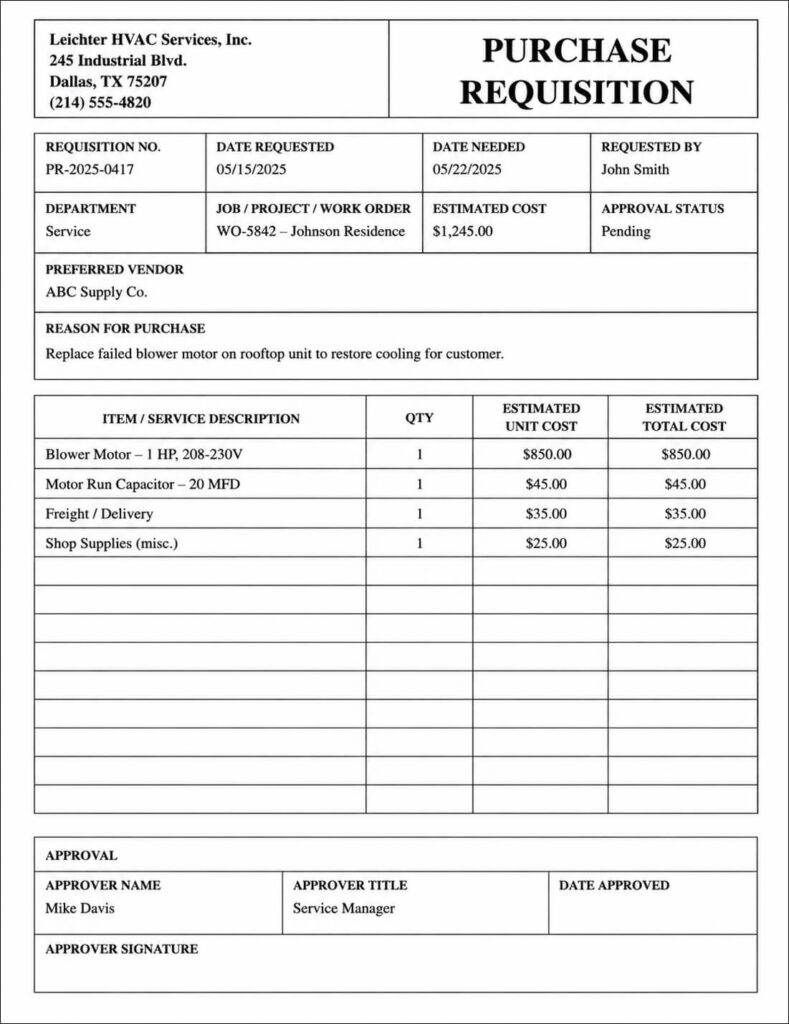
A good written purchase requisition usually includes:
For contractors, the job number or work order number is especially important. Without it, your bookkeeper may know your company bought materials, but not which job should carry the cost.
💡 Pro Tip: Require a Business Reason for Every Non-Routine Purchase
Don’t allow requisitions that simply say “needed” or “for job.” Require employees to briefly explain why the purchase is necessary. A one-sentence justification often reveals duplicate requests, overlooked inventory, or purchases that aren’t actually urgent before money gets committed.
The example below shows what a typical purchase requisition might look like, including the key information needed to evaluate, approve, and track a proposed purchase. While formats vary from one company to another, most requisitions capture similar details so decision-makers can determine whether the purchase is necessary, properly budgeted, and assigned to the correct job, project, or department.
A purchase order, or PO, is the formal document your business sends to a vendor to make a purchase. It tells the supplier what you are buying, how much you are buying, what price you agreed to, where the order should go, and what payment terms apply. For a deeper breakdown, read our article that explains the purchase order definition with examples and practical uses.
The Federal Acquisition Regulation describes a purchase order as an offer to buy supplies or services under specific terms. Government purchasing uses that definition, but any business owner can apply the same principle: a PO is not just a casual note. It is a structured buying document. You can review the official reference at Acquisition.gov.
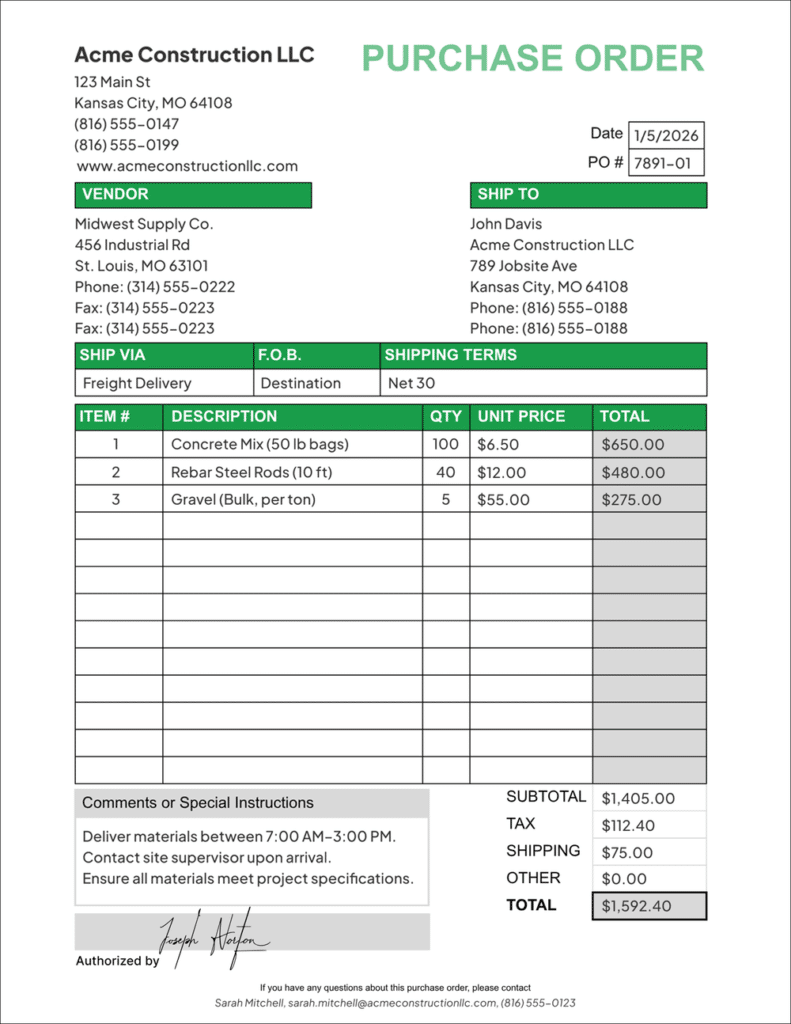
A thorough purchase order should always include:
The PO number becomes the reference point for everyone involved. The vendor uses it when fulfilling the order, your receiving team uses it when goods arrive, and accounts payable uses it when reviewing the invoice. Put a purchase order process in place so your team authorizes every purchase, tracks it accurately, and documents it from the initial request through final payment.
Seeing a purchase order in context makes it much easier to understand how it differs from a requisition. A requisition requests internal approval. A purchase order goes to the vendor after your team grants that approval. The example below shows the information typically included on a purchase order, including the PO number, vendor details, item descriptions, quantities, pricing, delivery instructions, and payment terms that guide the transaction from ordering through payment.
💡 Pro Tip: Never Reuse PO Numbers
Treat PO numbers like fingerprints; every purchase order should have its own unique identifier. When PO numbers get reused, invoice matching becomes unreliable, purchasing records become harder to audit, and small discrepancies can take hours to untangle when questions arise months later.
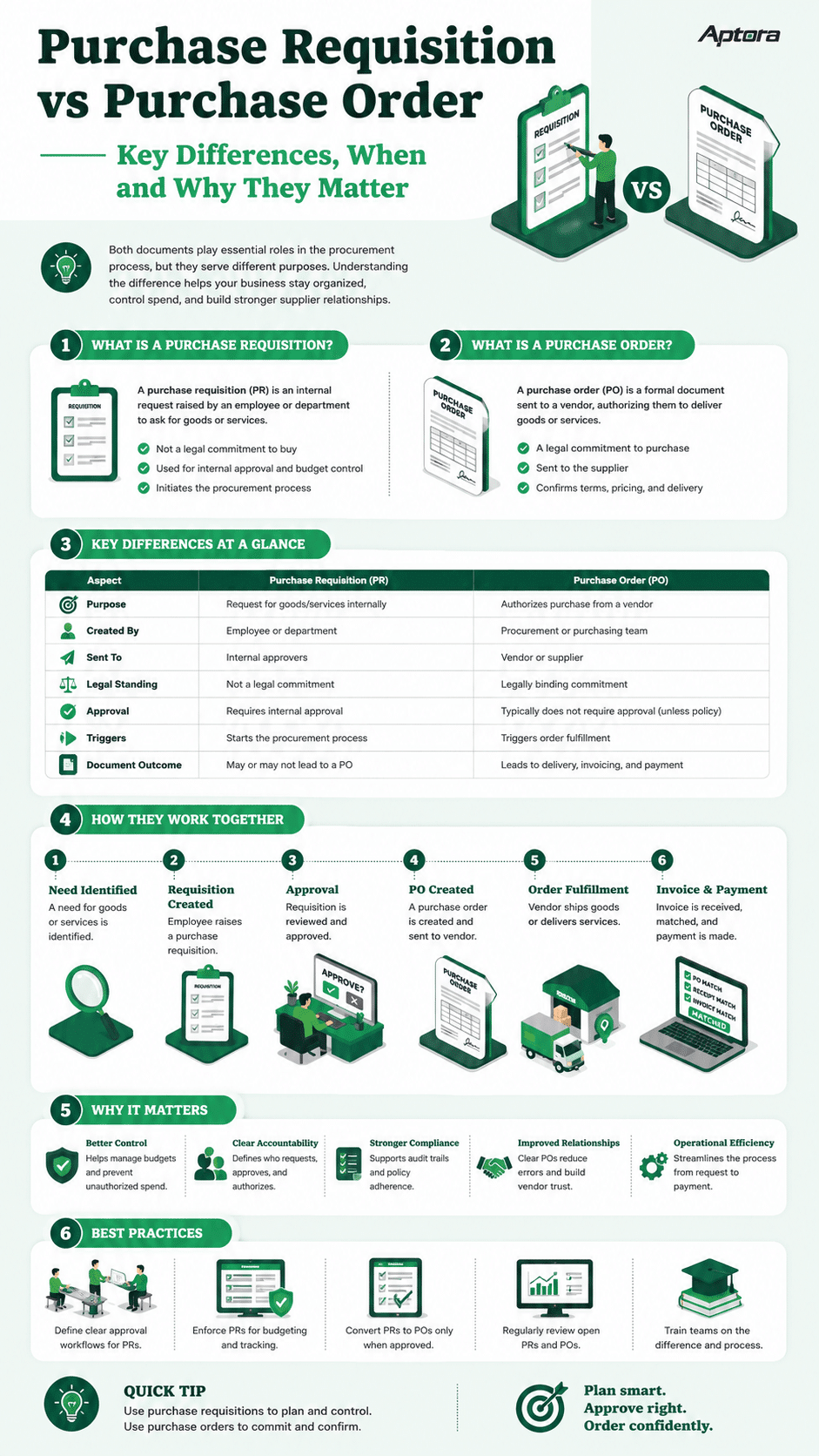
At this point, you can probably see the connection between purchase requisitions and purchase orders, but do not confuse them. They work together, but they do different jobs. Each serves a different purpose, appears at a different stage of the purchasing cycle, and provides a different layer of control.
The comparison below highlights the key differences between a purchase requisition and a purchase order so you can see exactly how they work together within a well-managed purchasing process.
| Purchase Requisition | Purchase Order | |
|---|---|---|
| Main purpose | Request approval to buy | Officially place the approved order |
| Audience | Internal team | Vendor or supplier |
| Timing | Before approval | After approval |
| Created by | Employee, technician, project manager, department lead, or requestor | Owner, office manager, purchasing manager, procurement team, or accounting |
| Sent to vendor? | Usually no | Yes |
| Financial commitment | Not yet committed | Usually commits the business once accepted by the vendor |
| Main control | Budget and approval control | Vendor, order, receiving, and invoice control |
| Common abbreviation | PR | PO |
| Accounting value | Shows why the purchase was requested and who approved it | Supports receiving, invoice matching, payment, and job costing |
The two documents work best as a sequence. The requisition starts the internal review. The purchase order starts the vendor transaction.
I’ve heard plenty of business owners say, “James, it’s all just paperwork. If my guy needs a part, he buys it.” and I can understand that mindset. When you’re trying to keep trucks moving and customers happy, paperwork just feels like friction.
BUT, the difference between requisition and ordering is not just paperwork for paperwork’s sake. It’s the difference between a request and a legally binding commitment.
The requisition protects you before the purchase, and the purchase order protects you after approval.
A clean purchasing workflow follows a simple order:
Enterprise organizations often call this a procure-to-pay or requisition-to-pay process. The terminology changes, but the principle stays the same whether you have 10 employees or 10,000: your team should know what they purchased, why they purchased it, who approved it, what arrived, and what the business ultimately paid.
At this point, the difference between a purchase requisition and a purchase order may seem straightforward on paper. But the real value of a requisition becomes much clearer when you see what can happen when that step is skipped altogether.
I have seen businesses lose thousands of dollars not because anyone acted dishonestly or incompetently, but because there was no process in place to slow down a purchase long enough to ask the few important questions. One HVAC contractor learned that lesson the hard way.
A residential HVAC company in Texas once called me after a job went sideways. A technician found a cracked heat exchanger during a maintenance call and told the office, “We need a new unit; order it now.”
Wanting to keep the customer happy and move quickly, they called the supply house and placed the order with a verbal PO. A requisition was never written. Inventory went unchecked. The customer’s financing was not verified. Even the unit orientation was never double-checked.
Three things went wrong.
First, the supply house shipped a downflow unit when the job required a horizontal unit. Second, the company already had a NEARLY IDENTICAL unit sitting in the warehouse from a previous return. Third, the customer’s financing fell through.
In the end, the company was left with a non-returnable, wrong-orientation air handler and a hard cost of just over $4,100.
When we dissected the mistake, we counted several instances where a simple purchase requisition would have safe guarded them from this catastrophe. A requisition would have forced someone to check inventory, verify the job requirements, confirm the customer status, and approve the order before the PO went out.
That is why I tell contractors that a formal purchase requisition is NOT bureaucracy. It is a financial airbag.
💡 Pro Tip: Urgent Does Not Mean Uncontrolled
Many purchasing mistakes happen when teams feel pressure to move quickly. Even during emergencies, take those two minutes to verify inventory, pricing, job requirements, and approvals. This simple step can prevent costly mistakes that take months to unwind.
From an accounting perspective, the difference between a purchase requisition and a purchase order goes far beyond purchasing procedures. Together, these documents create a paper trail that supports internal controls, cash flow management, job costing accuracy, tax documentation, and financial reporting.
Most business owners think about purchasing in terms of getting materials, equipment, or services when they are needed. Accountants look at it differently. They need to know who approved the purchase, why it happened, where the cost belongs, and whether the business actually received what it paid for.
That documentation becomes increasingly valuable as your business grows. In fact, the IRS explains that good recordkeeping helps business owners monitor business performance, prepare financial statements, track deductible expenses, prepare tax returns, and support items reported on those returns.
When used together, purchase requisitions and purchase orders help create that record trail by documenting:
I find that most purchasing problems eventually become accounting problems. A missing approval becomes a budget overrun. An uncoded material purchase becomes a job-costing issue. A poorly documented order becomes a vendor dispute (six months later when nobody remembers what happened).
That is why a requisition and PO process is about much more than buying things. It creates a historical record of decisions.
When a customer disputes a charge, an auditor asks for support, a project exceeds budget, or a tax question surfaces years later, those purchasing records often become the difference between having answers and having assumptions.
So, in essence, you’re not just controlling spending today. You’re creating a financial paper trail that protects your business tomorrow.
💡 Pro Tip: Keep Requisitions and POs Together
Store purchase requisitions, purchase orders, receiving documents, and invoices together whenever possible. When questions arise months later, having the entire purchasing trail in one place can save hours of research and eliminate guesswork.
A strong purchasing process separates duties. The person requesting the purchase should not always be the same person approving it, placing the order, receiving the goods, and paying the invoice.
Now, this does not mean a small business needs a GIANT purchasing department. It just means you need checkpoints.
For example:
❗ Important: This separation of duties protects the business from honest mistakes and outright fraud.
Don’t overcomplicate the first version of your process. Start with the few controls that matter most.
Set a dollar threshold and a few special rules.
For example, require a formal requisition for:
This keeps small, routine purchases from clogging the system while still controlling meaningful spending.
Every requisition should collect the same basic information. Keep it short enough that people will actually use it.
The best form is not the most detailed one. It is the one your team follows every day.
Decide who approves what.
A field supervisor might approve small material requests. A project manager might approve job-related purchases. The controller might approve overhead spending. The owner might approve large purchases, new vendors, or equipment.
Write those rules down.
Once approved, the requisition should become a purchase order. The PO should carry forward the job, item, vendor, and price information whenever possible.
This reduces duplicate data entry and prevents details from changing between approval and order.
Require that vendors include the PO number on invoices. This makes accounts payable much easier.
⚠️ If an invoice arrives without a PO number, it should be flagged for review.
A weekly open PO review helps you manage cash flow, backorders, job delays, and vendor performance.
This does not need to be a long meeting. Even 15 minutes can prevent expensive surprises.
Many businesses start with spreadsheets, and totally get why. A spreadsheet is cheap, familiar, and flexible.
At first, it may work fine. You can create columns for requisition number, request date, vendor, job number, approval status, PO number, invoice status, and payment status.
Though, the trouble starts when the spreadsheet becomes the system of record for too many people.
Someone saves a separate copy. Someone forgets to update a status. A formula breaks. A PO number gets reused. An approval happens by text and never makes it into the file.
Before long, the owner, accountant, and field team all have different versions of the truth which becomes very detrimental to your spending control.
Relying on spreadsheets becomes increasingly difficult for contractors because purchasing doesn’t happen in a vacuum. Every order affects inventory, job costing, work orders, vendor balances, accounts payable, and project profitability. If you find yourself spending more time updating spreadsheets, chasing information, and reconciling conflicting records than actually managing purchases, it may be time to move to a system designed to connect those moving parts automatically.
Aptora offers dedicated purchase order software designed to help track open POs, manage vendors, support reordering, connect purchasing to jobs, and reduce the guesswork that comes with spreadsheet-based purchasing.
If you are tired of wondering whether a part was requested, approved, ordered, received, invoiced, or billed to the right job, Aptora can help you move from spreadsheet chaos to purchasing control.
So, the difference between a purchase requisition and purchase order comes down to purpose, timing, and audience.
Again, a purchase requisition is an internal request for permission (it helps your business control spending before a purchase happens), and a purchase order is an external order sent to a vendor (it helps your business document the approved purchase, manage delivery, match invoices, and protect accounting records).
Used together, they create a clean workflow: Request. Approve. Order. Receive. Match. Pay.
That sequence may not sound exciting, but it can protect thousands of dollars, improve job costing, reduce duplicate orders, and make your accountant’s life much easier.
The purchase requisition comes first. It starts the approval process. Once approved, the business creates a purchase order and sends it to the vendor.
Usually, no. A purchase requisition is an internal request and does not normally create a vendor commitment. It simply asks for approval to buy.
A purchase order can become legally binding once accepted by the vendor, depending on the terms, communication, and applicable law. For practical business purposes, treat a PO as an official purchase commitment.
Yes. Very small businesses sometimes use purchase orders without formal requisitions, especially when the owner approves every purchase. However, as soon as multiple employees can request purchases, a requisition process helps prevent overspending and confusion.
Accountants use purchase orders to verify vendor invoices, support job costing, track committed costs, maintain audit trails, and prevent payment errors. A PO helps prove what was ordered, received, invoiced, and paid.

The Vendor Types List is used to manage and classify the various suppliers (vendors) from which you buy goods and services. Examples of vendor types
What is Unit of Measure (UOM)? Often companies purchase an item and sell that item in smaller portions. You might purchase a 20-foot piece of
Warranty Reserve Accounting A warranty reserve helps cover anticipated but unpredictable expenses. The concept applies to system replacements and other types of sales. It also
A subtotal is the sum of a group of amounts before you calculate the final total. On an invoice, a subtotal adds several item amounts