Vendor Types List: Which Categories Fit Your Suppliers?

The Vendor Types List is used to manage and classify the various suppliers (vendors) from which you buy goods and services. Examples of vendor types


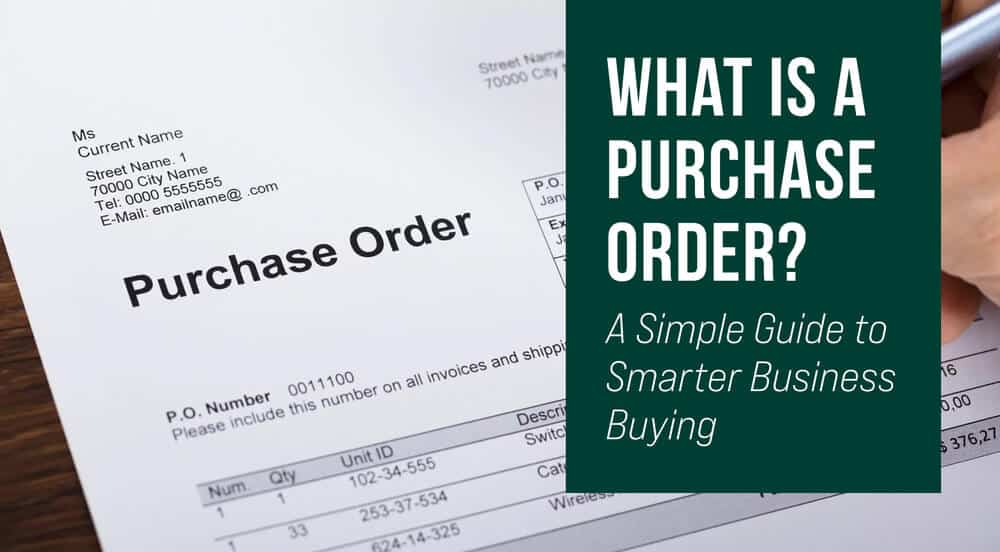
In simple terms, a purchase order (PO) is a document a buyer sends to a seller to confirm a purchase before it happens, laying out exactly what’s being bought, how much it costs, and the terms of the transaction. It brings order to the often chaotic process of buying materials, equipment, and services for your business.
I have seen many small business owners start without a formal PO process, and that can work for a while. But as your business grows, it becomes much harder to control spending, avoid billing mistakes, and stay organized without one.
No matter the size of your operation, I always promote having a solid PO process because it gives you that much needed control. It protects your cash, keeps vendor relationships running smoothly, and helps you avoid unnecessary headaches. From there, everything else gets easier to manage.
So, let’s break down what POs are in-depth, how they work, and how you can use them to run a tighter, more controlled business!
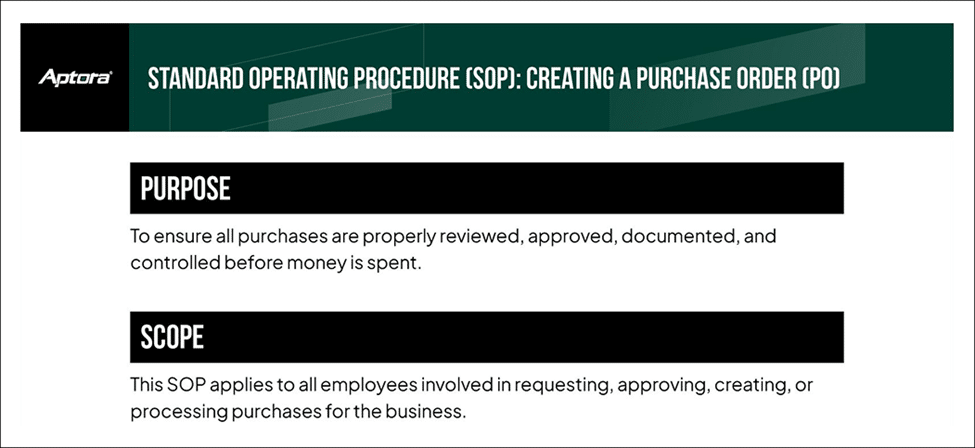
📥 Want a simple, repeatable process your team can follow to create a solid purchase order? Download our FREE Standard Operating Procedure (SOP) for Purchase Orders and start using a clear, structured workflow today!
If you’ve ever ordered materials, approved a vendor bill, or tried to figure out whether someone actually authorized an invoice, you have already bumped into the world of POs.
Unlike a quick verbal “yeah, send it over,” a PO creates a fixed record that lists precisely:
This document helps approve spending before money leaves a business. So, instead of reacting to invoices after the fact, you create a record upfront that tells your team and the vendor what you approved.
This adds structure to purchasing, giving your office a clear paper trail and your accounting team something to match against vendor invoices later.
As a small business owner, this helps you avoid common (and costly) mishaps like:
Without a PO process, people often rely on emails, texts, memory, or a spreadsheet (that often only one person understands). While this method of purchase management might seem easiest when a business is tiny, be aware that it usually breaks as operations grow.

Many new business owners assume POs are only for big companies or government agencies. They’re not. Even a small business can benefit from POs early on, especially once purchases happen regularly and more than one person on the team can place orders.
POs become especially valuable when your business starts buying things like:
When you use POs consistently, three critical parts of your business stay aligned:
Keeping these three areas connected helps your business run smoother and aids you in catching potential problems earlier on.
If you run a construction, HVAC, plumbing, electrical, service, or light manufacturing business, a PO system is often one of the first real processes that separates an operation that feels under control from one that constantly feels reactive.

A good PO should include enough detail to prevent confusion, but stay simple enough that your team can create one quickly. Most POs include the following:
💡 Pro Tip: The more specific your line items are, the fewer questions or disputes you’ll have to deal with later. So, I encourage you to, instead of saying something like “Materials for remodel” in your PO item descriptions, try “40 sheets 1/2-inch drywall, delivered to Job 2417.” This level of detail is much more useful.
Before a PO can do its job, it needs the right information in the right places. A well-built PO is not just a form. It gives your vendor, your team, and your accounting person clear instructions they can follow without guessing. Each section plays a specific role, and when something is missing or vague, that’s where mistakes, delays, and overpayments start to creep in. So, let’s go over the bones of it.
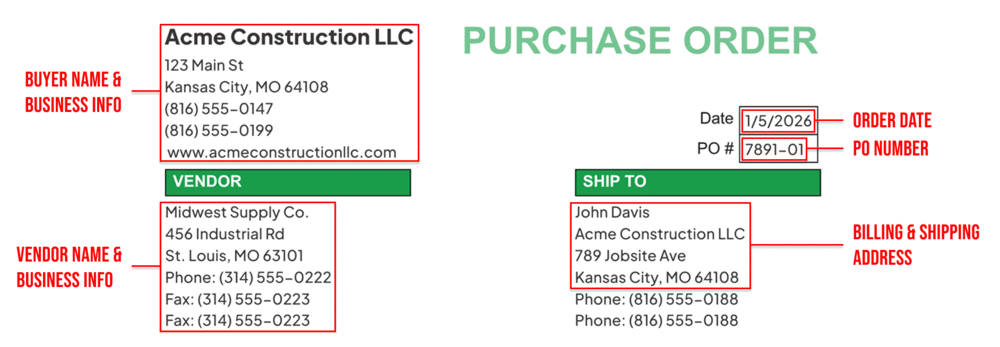
This section identifies who the order is between and anchors the entire transaction.
Here is where you’ll include your company name, address, and contact information, along with the vendor’s full details. You’ll also want to add the date the PO is issued, and most importantly, the PO number.
📌 Note: The PO number shows up later on the invoice and gives your accounting team the key they need to match what you ordered against what the vendor billed. If that number is missing or inconsistent, everything slows down, and it is one of the fastest ways to create friction in your payable process.

This is where the actual purchase is defined, and it needs to be specific.
Each product or service should have its own line with a clear description, quantity, unit price, and total cost. The goal is simple: anyone who reads the PO should understand exactly what you’re buying without needing to ask follow-up questions.
Again, be precise. Write “12-gauge THHN solid copper wire, 500-foot spool” instead of just “wire.” The more detail you include here, the easier it is to verify invoices and hold vendors accountable.

This section defines the rules of the transaction and protects you when something goes wrong.
Spell out payment terms like Net 30 or 2% if paid within 10 days. Include delivery expectations, shipping method, and any job-specific instructions. If there are requirements around materials, certifications, or compliance standards, this is where they go.
I once had a plumbing client avoid a $15,000 loss because their PO clearly stated “must meet ASTM B124 standard.” So, when the supplier tried to substitute cheaper fittings, the clearly documented requirement forced them to replace everything at their own expense.
If you don’t write it here, you’ll have a much harder time enforcing it later.

This is what makes the PO official.
Someone with spending authority needs to review, approve, and sign each PO before your team sends it to the vendor. In a small HVAC shop, that might be you. In a larger operation, it could be a service manager or operations lead.
Without that approval, a PO is just a document and it won’t put the proper controls around spending. This step is what prevents unauthorized purchases and keeps your team accountable.
One question I ask every owner I work with: “Does your team know how to fill out every field on a PO without guessing?” If the answer is “no,” you’re leaving too much room for errors, and those errors usually show up as lost money.
So, don’t leave it up to guesswork. Train your team, set clear standards, and make sure every PO is filled out the same way, every time.
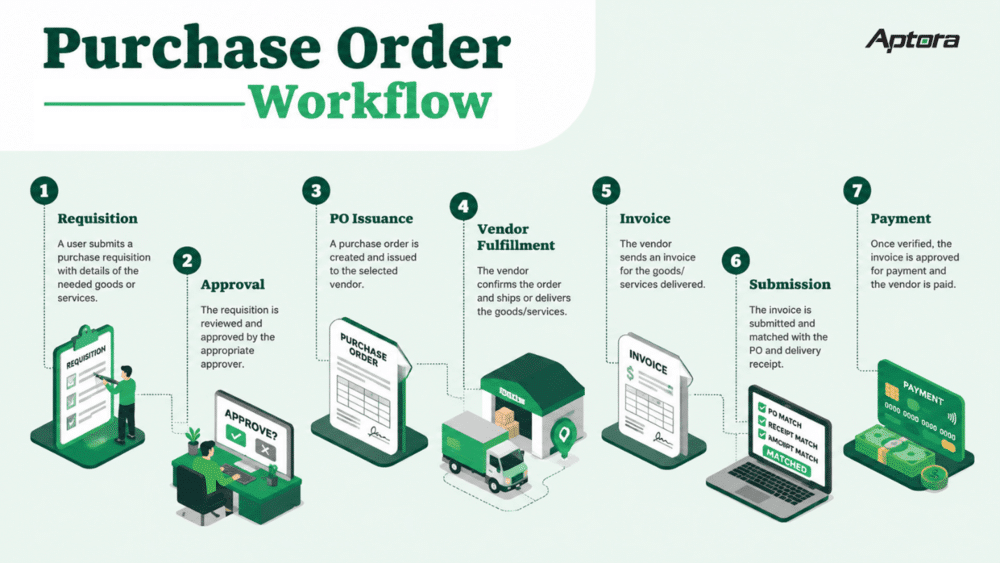
Understanding what a PO is only gets you part of the way there. To actually control spending and avoid confusion, you also need to understand the basic purchase order approval workflow.
At a high level, the process usually moves through these steps:
💡 Pro Tip: Separate request, approval, and receipt when you can. In a small company, one person may wear multiple hats, but try not to let the same person request, approve, receive, and reconcile the same purchase whenever possible. Separation of duties can help prevent mistakes and reduce the chance of fraud.
Back in the 90s, there was a simple little scam that worked far better than it should have. Someone would call an office pretending to be a service technician or representative from the company’s copier or printer vendor.
Nothing dramatic. No hard sell. Just a polite voice asking something like, “Hey, quick question, can you read me the serial number off your office printer?”
Seems harmless, right?
Someone in the office walks over, reads the number, and that’s the end of it.
Except it wasn’t.
A few weeks later, an invoice would show up. And it would look legitimate. It might reference the right printer model, include the correct serial number, and bill for something routine like toner, supplies, or maintenance.
Nothing outrageous. Nothing that immediately screams “scam.”
So, the company pays it.
Not because they were careless, but because everything looked right. The details matched. The charge seemed believable. The invoice fit neatly into their reality, and that is the trap.
When your system relies on whether an invoice looks familiar, you’re not really controlling spending. You’re reacting to it.
This is why the PO process matters.
A purchase order moves you from after-the-fact validation to upfront control. Instead of asking, “Does this invoice look legitimate?” you ask a much better question: “Did we approve this before it happened?”
That is what two-way and three-way matching are designed to enforce:
So, even if a scammer sends an invoice with the right printer model, the right serial number, and a believable price, it still should not matter.
No PO? No payment.
That is the point of a strong PO process. It does not rely on memory, intuition, or appearances. It gives you a system where every purchase gets planned, approved, and verified before money ever leaves your account.
In many cases, yes. A PO becomes legally binding once the supplier accepts it and either ships the goods or begins the work under the terms you laid out. At that point, it is no longer just a request. It is an agreement both sides are expected to follow.
That said, what the PO actually enforces depends on the details. Your terms, the vendor’s terms, and the laws that apply to the transaction all play a role. For example, if your PO says Net 30 but the vendor’s invoice says Net 15, which one controls? The answer depends on what was agreed to and whether there is a separate contract in place.
For larger purchases, ongoing services, or construction work, there is usually a formal agreement that defines pricing, scope, liability, and dispute terms. In those cases, the PO acts as the authorization to proceed under that broader contract, not a replacement for it.
So, the practical takeaway here is simple. Do not treat POs like casual internal notes. They are part of your financial and legal record. Vendors rely on them to deliver work, and your accounting team relies on them to release payment. If something goes wrong, the PO is one of the first documents everyone looks at.
For more on when a PO becomes a binding contract, what it must include, and how they work under the Federal Acquisition Regulation (FAR), see FAR Part 13.302 on Acquisition.gov.
Not every PO is the same or is used the same way. The type you choose will depend on what you’re buying and how often you expect to buy it. Some purchases are one-time and clearly scoped. Others are ongoing, repeat, or tied to a broader agreement with a vendor.
Using the right type of PO helps you avoid unnecessary paperwork, keep purchasing consistent, and stay in control as your volume grows. Here are the main types of POs you will come across and when to use each one:
A standard PO is the most common and straightforward type of PO. You know exactly what you are buying, how much, and at what price when you create the PO.
Use this for one-time or clearly defined purchases. You approve it, send it, receive the goods or services, and close it out.
If most of your purchases are job-specific or one-off, this will likely be your default.
A planned PO is used when you know you will need certain items or services, but you do not yet know the exact timing or quantities.
You are essentially pre-approving a category of spending with expected pricing, then releasing portions of it over time as needed.
This works well for things like recurring materials or vendor relationships where demand is predictable, but not fixed. It gives you structure without forcing you to rewrite a new PO every time.
A blanket PO is designed for repeated purchases from the same vendor over a set period, usually with agreed pricing and a spending limit.
Instead of issuing a new PO for every order, your team can place orders against the same blanket PO until the limit or time period is reached.
This is common for:
💡 Pro Tip: I’ve seen this type of PO turn into an open tab, when no one is monitoring usage. A blanket PO is great for reducing admin work, but it needs oversight. Don’t start skipping the checks and balances when using this type of PO.
A contract PO sits on top of a formal agreement with a vendor.
The contract defines the legal terms, pricing structure, scope of work, and responsibilities. The PO is then used to authorize specific purchases under said agreement.
You will see this in:
In this setup, the PO is not setting all the terms. It is confirming and authorizing purchases under an agreement that already exists.
| PO Type | When to Use It | What You Know Upfront | How It Works | Best For | Key Risk |
| Standard Purchase Order (SPO) | One-time or clearly defined purchases | Exact items, quantities, pricing, and timing | Created, approved, fulfilled, then closed | Job-specific buys, equipment, one-off services | Low risk, but can create admin overload if overused |
| Planned Purchase Order (PPO) | Recurring needs with uncertain timing or quantities | General scope, estimated quantities, and pricing | Pre-approved, then released in portions over time | Predictable but variable demand (materials, repeat vendors) | Poor tracking can lead to over- or under-ordering |
| Blanket Purchase Order (BPO) | Frequent, repeat purchases from the same vendor | Pricing terms and total spending limit (not individual orders) | Orders are placed against a single PO until limit or time expires | Consumables, supplies, preferred vendor relationships | Can turn into an “open tab” without strict oversight |
| Contract Purchase Order (CPO) | Ongoing work tied to a formal agreement | Terms, pricing structure, and scope defined in a separate contract | PO authorizes purchases under an existing contract | Subcontractors, rentals, service agreements | Confusion if contract and PO terms are not aligned |
These three documents show up in the same transaction, and businesses mix them up all the time. I see it constantly. Someone treats an invoice like approval. Someone treats a receipt like proof of price. Or worse, a business pays a bill without ever checking it against what they originally ordered.
Each document serves a different purpose, and if you blur those roles, you lose control of the process. If you want a deeper breakdown, I cover the differences in more detail in this guide: Purchase Order vs Invoice
Created by the buyer before anything is delivered.
This is the approval step. It defines what the business has agreed to buy, including items, quantities, pricing, and terms.
If it is not on the PO, it was not formally approved.
Created when your team confirms that the goods arrived or the service was completed.
This is the verification step. It answers a simple question: did we actually get what we ordered?
Without this, you are relying on the vendor’s invoice as proof of delivery, which is where a lot of overpayments start.
Created by the vendor after delivery.
This is the request for payment. It should reflect what was approved on the PO and what was actually received.
An invoice by itself is not proof that something was approved or delivered. It is just a bill.
That separation is what keeps your accounts payable process under control. When all three line up, you can pay with confidence. When they don’t, that’s your signal to stop and investigate before money goes out!
| Document | Created By | When It’s Created | Purpose | Key Question It Answers | What It Includes | Risk If Missing |
| Purchase Order | Buyer | Before goods/services are ordered | Authorization | Did we approve this purchase? | Items, quantities, agreed pricing, terms | Unauthorized purchases, pricing disputes |
| Receipt | Buyer (or receiving team) | When goods/services are received | Verification | Did we actually receive it? | Quantities received, condition, date received | Paying for items not received or incomplete delivery |
| Invoice | Vendor | After delivery | Payment request | What are we being asked to pay? | Billed items, amounts due, payment terms | Overpayment, duplicate payment, fraudulent billing |
Here are another two that get mixed up all the time, especially in smaller businesses where the same person is requesting, approving, and ordering.
The difference matters because it separates asking for something from approving the spend. If you blur that line, you lose control before the PO is ever even created.
For a closer look at where one ends and the other begins, see this guide on purchase requisition vs purchase order.
A purchase requisition is simply an internal request.
With this, someone on your team is saying, “We need to buy this.” It should include what is needed, why it is needed, which vendor is preferred, and which job, department, or budget it belongs to.
At this stage, nothing has been approved yet. It is simply a request to spend money.
A PO is the approved document sent to the vendor.
This reflects a decision that has already been reviewed and authorized. Once it is issued, the business is formally committing to the purchase under the stated terms.
The ordering process for your business should always follow the same path: request first, then review and approval, then the PO is issued to the vendor.
If your business is still small, you may not use a formal requisition form yet, and that is fine. But you still need a clear-cut turning point where a request becomes an approved purchase.
Without that separation, requests become automatic, orders happen without real oversight, and spending decisions end up with no clear owner.
That is how small leaks turn into real money lost over time.
| Document | Created By | When It’s Created | Purpose | Key Question It Answers | Who Sees It | What It Includes | Risk If Missing |
| Purchase Requisition | Employee / Requester | Before any approval or ordering | Request | Should we buy this? | Internal only | Item/service needed, reason, preferred vendor, budget/job coding | Uncontrolled requests, no clear review process |
| Purchase Order (PO) | Buyer / Purchasing / AP | After approval, before purchase is finalized | Authorization & Commitment | Has this been approved to purchase? | Sent to vendor + internal | Approved items, quantities, pricing, terms, delivery details | Unauthorized purchases, pricing disputes, overspend |
You do not need a huge volume of purchases for PO mistakes to become expensive. A few small errors repeated over time can eat profit fast.
Here are the most common PO mistakes and the problems they create:
Above all, a messy PO system makes budgeting harder. You lose visibility into what has been ordered, what is still pending, and what is already complete, which makes it difficult to manage cash and plan ahead.
A PO system should get stronger as your company gets busier, not weaken and fall apart. Here are some habits that can make a big difference in keeping it together:
If you want a more formal reference on PO structures and controls, the New York State Office of the State Comptroller’s PO guide and East Carolina University’s invoice matching guide are helpful starting points.
Yes. For a while.
A spreadsheet is often where small businesses begin with managing their POs. It is cheap, familiar, and easy to set up. But, it usually becomes painful once you add more vendors, more jobs, more approvals, more invoices, and more people touching the process.
Spreadsheets struggle with things like:
Don’t get me wrong, the problem here is not that spreadsheets are “bad.” The problem is that they depend too much on human memory and manual discipline. One missed email or one overwritten formula can throw off your whole process and, for a business owner or amateur accountant, that is exhausting.
Once your purchasing starts touching large projects, field teams, inventory, vendors, and accounting, purchase order software usually becomes the better choice.
A good system should help you:
This is especially important in construction and field service, where purchasing is tied directly to job profitability. Materials ordered late, priced wrong, or billed incorrectly do not just create accounting clutter. They affect margins.
At the end of the day, a purchase order is not just another piece of paperwork for your office to file away.
It is a control tool.
A good PO process helps your business slow down just enough to ask the right questions before money goes out. What are we buying? Who approved it? What should it cost? Did we actually receive it? Does the invoice match what we agreed to?
Those questions may seem simple, but they are where a lot of expensive mistakes get caught.
You do not need a perfect system on day one. But you do need a consistent one. Start with clear approvals, detailed line items, proper receiving records, and a rule that invoices do not get paid just because they look familiar.
As your business grows, the companies that stay profitable are usually not the ones that buy the least. They are the ones that know what they are buying, why they are buying it, and whether the invoice matches what was approved.
That is what a good purchase order process gives you: control before the cash leaves your account.
Yes, but any changes should be formally documented and reapproved, often through a revised PO or change order. Both you and the vendor should clearly acknowledge the update to avoid disputes later.
You lose pre-approval control, which increases the risk of unauthorized spending or pricing discrepancies. Many businesses choose to reject or delay payment until proper documentation is provided.
Most businesses retain POs for at least 3–7 years for accounting, audit, and tax purposes. The exact timeframe can vary depending on local regulations and your company’s recordkeeping policy.
Typically, the person closest to the need (like a project manager or office admin) creates the PO, but it should always be approved by someone with spending authority. Clear role separation helps maintain accountability.
They can be either, but digital POs are easier to track, search, and integrate with accounting systems. As volume grows, most businesses move to digital to reduce errors and improve efficiency.

The Vendor Types List is used to manage and classify the various suppliers (vendors) from which you buy goods and services. Examples of vendor types
What is Unit of Measure (UOM)? Often companies purchase an item and sell that item in smaller portions. You might purchase a 20-foot piece of
Warranty Reserve Accounting A warranty reserve helps cover anticipated but unpredictable expenses. The concept applies to system replacements and other types of sales. It also
A subtotal is the sum of a group of amounts before you calculate the final total. On an invoice, a subtotal adds several item amounts