Vendor Types List: Which Categories Fit Your Suppliers?

The Vendor Types List is used to manage and classify the various suppliers (vendors) from which you buy goods and services. Examples of vendor types


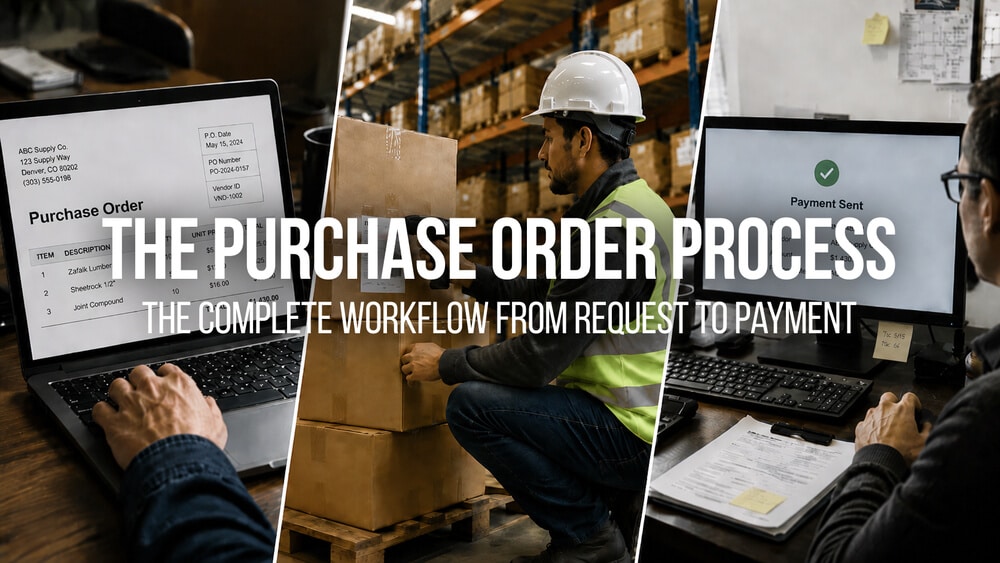
The purchase order (PO) process is the step-by-step workflow businesses use to control purchasing, approve spending, document vendor agreements, verify deliveries, and pay invoices accurately. The basic sequence of the PO process is:
Though, in practice, a PO process is far more than just a series of formalities, paperwork, and approvals.
Done correctly, a PO process becomes one of the strongest financial control systems in your business. Done poorly, it becomes little more than administrative theater: forms created after the fact, invoices approved blindly, and cash leaking out through mistakes nobody catches until months later.
I’ve seen contractors lose thousands of dollars from something as simple as paying duplicate invoices or allowing field purchases without approval. In many cases, nobody intended to do anything wrong. The process itself just simply failed to create visibility or accountability.
That is why understanding the PO workflow matters so much.
Whether you run a construction company, manufacturing operation, service business, or growing small business, a well-structured PO process helps you:
So, the PO process is not just for large corporations with complicated procurement departments. Even small companies benefit tremendously from introducing simple purchasing controls early.
One of the biggest mistakes growing businesses make is waiting until spending problems become painful before implementing structure. By then, employees have already established habits, vendors have grown accustomed to informal purchasing, and teams resist the change.
The businesses that scale most successfully usually build purchasing discipline long before they technically “need” it.
The PO process is the complete workflow a company follows when buying goods or services, starting with the initial request and ending with payment to the vendor.
At its core, the process exists for one primary reason:
To make sure money leaves the business intentionally, accurately, and with proper authorization.
A PO itself is simply one document inside that larger workflow.
That distinction matters because many businesses mistakenly believe they “have a PO process” simply because they occasionally create POs. But, if approvals happen verbally, invoices bypass review, or accounting pays bills without verification, the actual process is weak regardless of how many forms exist.
A proper PO workflow creates checkpoints throughout the purchasing cycle so that:
Without those controls, purchasing quickly becomes reactive instead of managed.
I remember working with a contractor years ago who believed his company had a theft problem because material costs kept climbing unexpectedly. After reviewing the workflow, the issue turned out to be much simpler: supervisors were ordering materials directly from suppliers without consistent approvals or job coding. The accounting department had invoices, but staff had no reliable way to verify whether managers authorized the purchases or tied them to the correct projects.
Once they implemented a structured PO process, the “mystery losses” largely disappeared within a few months. Most of the problem was not fraud. It was lack of process visibility. That scenario is far more common than most owners realize.
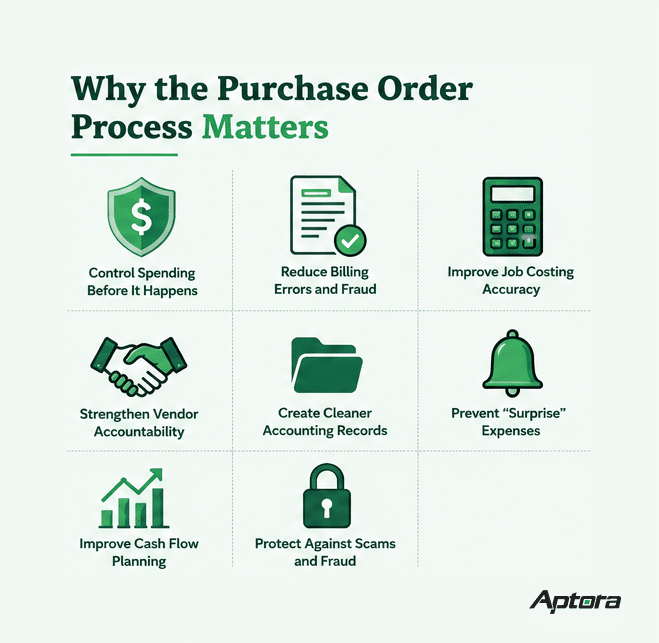
A strong PO process does far more than help accounting stay organized. It directly impacts profitability, operational control, and financial accuracy.
Without a purchasing workflow, businesses often encounter problems like:
❗ The larger the company becomes, the more damaging these problems get.
In smaller businesses, owners sometimes rely on memory and informal conversations to manage purchasing. That can work temporarily when only a few people are involved. But, once purchasing volume increases, verbal approvals and disconnected spreadsheets stop scaling.
The PO process creates structure.
It transforms purchasing from:
“I think we approved this…”
into:
“Here is exactly what was approved, who approved it, when it was approved, and what was actually received.”
That level of visibility becomes incredibly valuable during:
Perhaps most importantly, it reduces decision fatigue for owners and managers. Instead of personally reviewing every single invoice from scratch, leaders can trust the workflow itself to enforce purchasing controls consistently.
Understanding what a PO is only gets you part of the way there. To actually control spending and avoid confusion, you need to understand how a PO moves through your business from start to finish.
The PO process is far more than just:
“create form, send form.”
It is a full purchasing control system that starts before someone places the order and ends only after staff verify the invoice and issue payment.
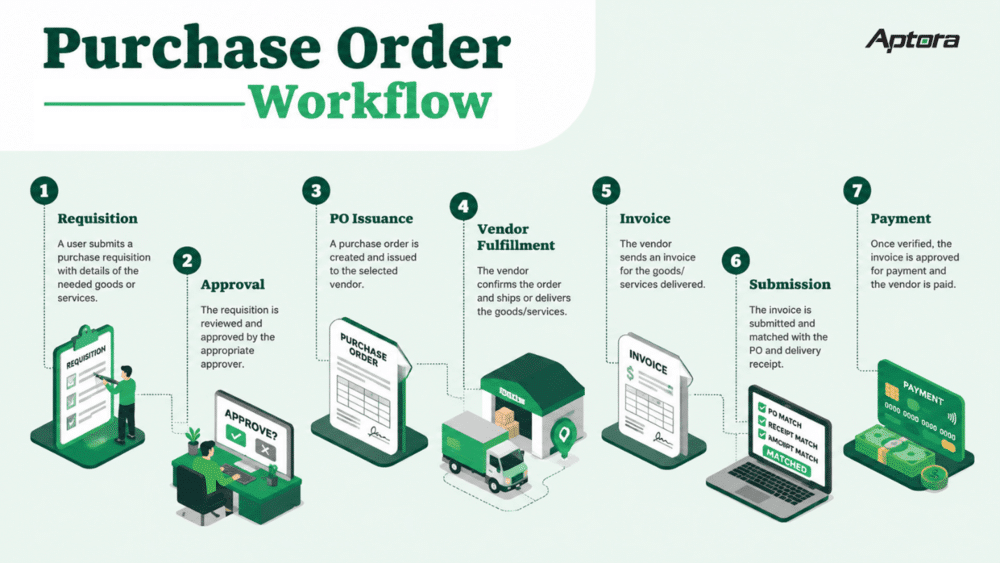
Again, the typical PO process follows this sequence:
Requisition → Approval → PO Issuance → Vendor Fulfillment → Invoice Matching → Submission → Payment
Now, let’s break down each of these steps in detail.
The process usually begins with a purchase request, often called a requisition.
A field manager, office administrator, project manager, department lead, or owner identifies a need for:
At this stage, the request should answer these few important questions:
The requisition stage matters because it creates visibility before money is committed.
Without it, purchases often happen impulsively. Employees buy first and explain later, which may feel faster in the moment, but it usually creates downstream accounting problems and weakens spending control.
That lack of visibility becomes increasingly expensive as a business grows and more employees begin purchasing independently.
One contractor I worked with discovered multiple crews ordering the exact same materials from different suppliers because nobody had centralized visibility into purchasing requests. The result was duplicate deliveries, inconsistent pricing, and wasted inventory sitting unused on jobsites.
The requisition process alone solved much of that inefficiency.
💡 Pro Tip: Standardize Requisition Information
The more consistent your requisition format is, the easier approvals and accounting become later. Be sure that every request includes the same key information in the same format. This way, reviewers can process purchases faster and with fewer mistakes.
Before sending the PO to the vendor, someone with spending authority should review and approve the request.
Depending on the company, that approver may be:
This step is one of the most important financial controls in the entire workflow.
If the business skips approvals, the PO stops functioning as a control mechanism, and the business loses one of the primary benefits of the PO process: preventing unnecessary spending before it occurs.
Strong approval procedures typically evaluate:
In growing businesses, approval thresholds are especially helpful. For example:
This structure helps prevent bottlenecks while maintaining accountability.
💡 Pro Tip: Avoid “Rubber Stamp” Approvals
Approvals should involve actual review, not automatic clicking. Ensure that each approver verifies that the purchase is necessary, reasonable, properly budgeted, and aligned with the business’s needs before signing off on it. If approvals begin to happen without scrutiny, the process loses effectiveness quickly.
Once someone approves the PO, the system generates it and sends it to the supplier.
This document becomes the official record of:
The business should always create a clear, complete PO and issue it before the vendor delivers goods or services whenever possible.
Creating POs after invoices arrive is one of the most common process failures businesses fall into. When that happens, the PO merely documents a purchase that already occurred instead of controlling it beforehand.
That distinction matters enormously.
A legitimate PO process authorizes spending in advance.
It does not simply create paperwork after the fact to satisfy accounting requirements.
I once reviewed a company where employees created nearly every PO after vendor delivery. Technically, they “used POs,” but the system provided almost no financial control because the company had already made the purchasing decisions.
I strongly advise that you avoid falling into this costly habit.
After the vendor fulfills the order, the business should confirm what it actually received.
That confirmation may come through:
This step is critical because it creates evidence of actual delivery, not merely intended delivery.
This is where having a tight receiving process becomes important. Without a receiving process, accounting has nothing reliable to compare against the invoice later.
That is how companies end up paying for:
Receiving verification is especially important in construction, manufacturing, and inventory-heavy businesses where partial deliveries and substitutions are common.
💡 Pro Tip: Verify Quantities Immediately
Discrepancies are much easier to resolve the same day materials arrive than weeks later after documentation disappears and memories fade. Have whoever receives the delivery compare the shipment directly against the PO and packing slip before signing off or storing the materials.
After accounting receives the invoice, the team compares it against the purchase documentation before approving payment. This step is commonly called invoice matching, and it serves as one of the most important financial control points in the entire purchase order process.
The goal is simple: confirm that the business is paying only for what was actually approved and received.
The two most common matching methods are:
Two-Way Match
Compares:
Three-Way Match
Compares:
With a three-way match, payment should not move forward until all three documents align. If the quantities, pricing, or details do not match, the discrepancy gets flagged for review before money leaves the business.
This process helps catch issues like:
This is one area where weak businesses quietly lose a lot of money over time.
I have seen accounting departments pay invoices simply because “the vendor looked familiar.” No PO, receiving documentation, or approval trail. Just an invoice arriving by email and somebody processing it automatically. That is exactly how duplicate payments, billing errors, and fraudulent invoices slip through unnoticed.
💡 Pro Tip: Require PO Numbers on Invoices
For every order, require your vendors to reference the PO number directly on every invoice. This dramatically speeds up verification and reduces confusion.
Learn the key differences between a purchase order vs invoice, including when each document is created, who sends it, and how they work together in the purchasing process.
After the vendor completes delivery, they formally submit an invoice requesting payment. This step moves the purchase from operational activity into the accounting workflow, where the invoice is reviewed, verified, and prepared for payment.
To process correctly, the invoice should include:
If required information is missing, the invoice should be returned for correction rather than pushed through manually. Otherwise, accounting teams end up wasting time chasing missing details, correcting errors, and resolving avoidable payment issues later.
This step also standardizes how invoices enter the business. So, instead of:
…the business creates a consistent intake process that accounting can review, track, and manage efficiently.
As companies grow, invoice submission procedures become increasingly important. Informal systems that work at 20 invoices per month often break down completely at 500. A standardized submission process helps ensure invoices are routed correctly, reviewed consistently, and far less likely to slip through the cracks.
At this stage, accounting schedules payment according to the agreed vendor terms while performing one final review to make sure the transaction is accurate, authorized, and fully supported by documentation.
Payment is typically scheduled according to common terms such as:
Before payment is issued, the business should confirm that:
If discrepancies appear, this is the final opportunity to stop incorrect payments before money leaves the account. Pricing errors, duplicate invoices, unauthorized charges, and billing for items never received are often caught here when the process is functioning properly.
This last step is where purchasing control becomes actual cash protection.
Done correctly, the business pays:
No more. No less.
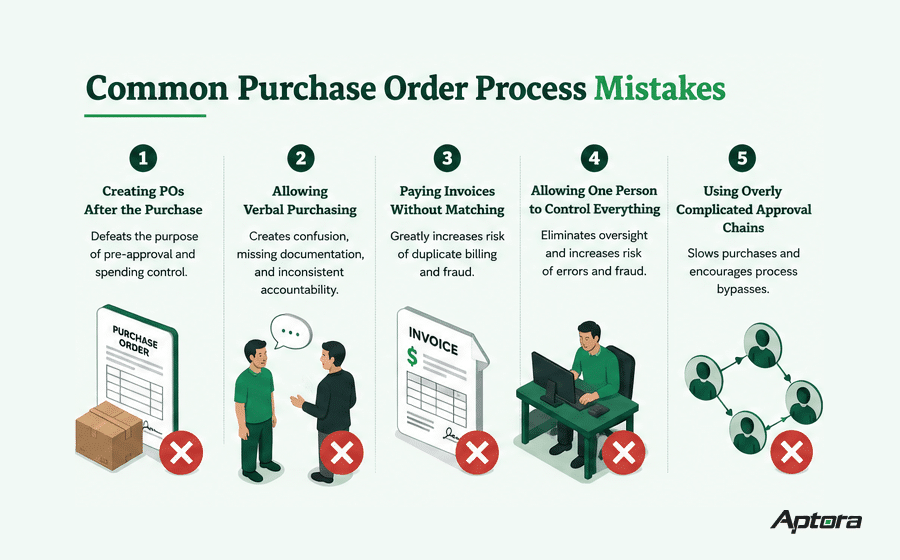
Even businesses with formal PO systems often make critical workflow mistakes.
Some of the most common include:
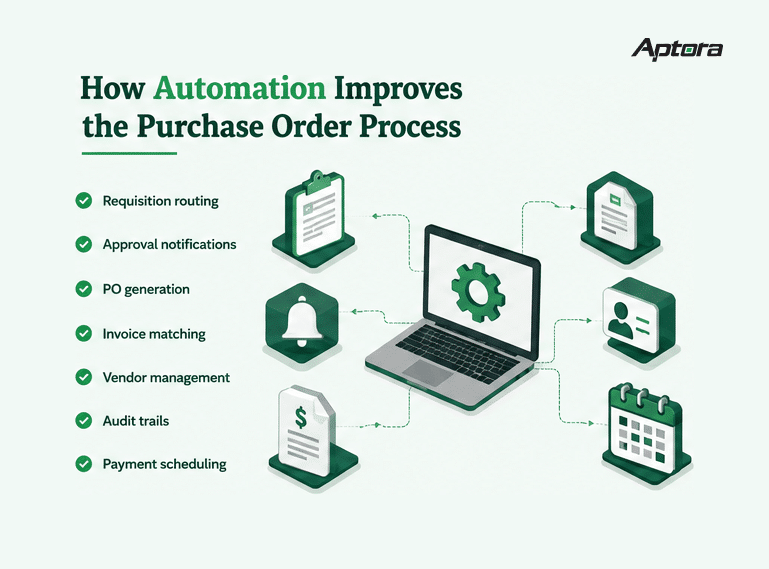
As businesses grow, manual PO systems become increasingly difficult to manage.
Paper forms, spreadsheets, emailed approvals, and disconnected accounting systems create:
Modern purchase order automation software can automate much of the workflow, including:
Automation also improves visibility. Managers can quickly see:
That level of real-time insight becomes increasingly valuable as purchasing volume increases.
That said, software alone does not fix broken processes.
A poorly designed workflow automated through software simply becomes a faster poorly designed workflow.
The underlying purchasing rules and responsibilities still matter.
💡 Pro Tip: Separate Request, Approval, and Receipt Whenever Possible
In smaller companies, employees often wear multiple hats and that is normal. Still, try not to allow the same person to: request purchases, approve purchases, receive deliveries, and reconcile invoices whenever possible. This separation of duties is one of the most effective internal controls a business can implement to reduce the chances of innocent mistakes, unauthorized purchases, duplicate payments, and fraud opportunities.
A purchase order process is not about creating unnecessary bureaucracy. It is about creating visibility, accountability, and financial control throughout the purchasing cycle.
The businesses that manage purchasing well are usually the same businesses that forecast cash flow more accurately, control job costs more effectively, scale operations more smoothly, and avoid unnecessary financial surprises.
Fortunately, a strong PO process does not need to be overly complicated to work well. Even a relatively simple workflow with clear approvals, documented purchasing, invoice matching, and receiving verification can dramatically reduce waste and improve financial clarity.
The key is consistency.
Because at the end of the day, purchasing problems rarely come from a single catastrophic mistake. More often, they come from dozens of small uncontrolled transactions that slowly erode profitability over time.
A strong PO process helps stop that erosion before it starts.
Purchase orders are commonly used in industries like construction, manufacturing, healthcare, retail, logistics, hospitality, and government. Any business that regularly purchases materials, equipment, inventory, or services can benefit from a PO process.
Retention requirements vary by industry and jurisdiction, but many businesses keep purchase orders and related accounting records for at least 5 to 7 years. Keeping organized records is important for audits, tax documentation, and dispute resolution.
Yes, but changes should be formally documented and reapproved when necessary. Many businesses issue a revised PO or change order so there is a clear record of updated quantities, pricing, or scope changes.
A two-way match is often sufficient for lower-risk purchases where receiving verification is less critical, such as recurring services, software subscriptions, utilities, or small office supply orders. Higher-risk purchases involving inventory, materials, equipment, or large dollar amounts typically benefit from a three-way match for stronger control.
When an invoice does not match the purchase order, payment should typically be paused until the discrepancy is reviewed and resolved. The business may need to confirm quantities received, verify pricing changes, request corrected invoices, or approve updated purchase terms before processing payment. Catching these issues early helps prevent overpayments and vendor disputes later.

The Vendor Types List is used to manage and classify the various suppliers (vendors) from which you buy goods and services. Examples of vendor types
What is Unit of Measure (UOM)? Often companies purchase an item and sell that item in smaller portions. You might purchase a 20-foot piece of
Warranty Reserve Accounting A warranty reserve helps cover anticipated but unpredictable expenses. The concept applies to system replacements and other types of sales. It also
A subtotal is the sum of a group of amounts before you calculate the final total. On an invoice, a subtotal adds several item amounts