Vendor Types List: Which Categories Fit Your Suppliers?

The Vendor Types List is used to manage and classify the various suppliers (vendors) from which you buy goods and services. Examples of vendor types


A purchase order (PO) is the document a buyer sends before a purchase to authorize and document what they intend to buy, whereas an invoice is a document the seller sends after delivering goods or services to request payment.
For a deeper breakdown of how POs work, read our guide: What is a Purchase Order?
In simple terms:
Purchase orders help businesses control spending before they commit money, while invoices help sellers collect payment after they complete work or deliver products.
Although they’re closely related, confusing the two can create duplicate payments, unauthorized spending, accounting headaches, and vendor disputes. So, let’s break down their key differences, when businesses use each document, and how they work together to keep business spending organized and under control.
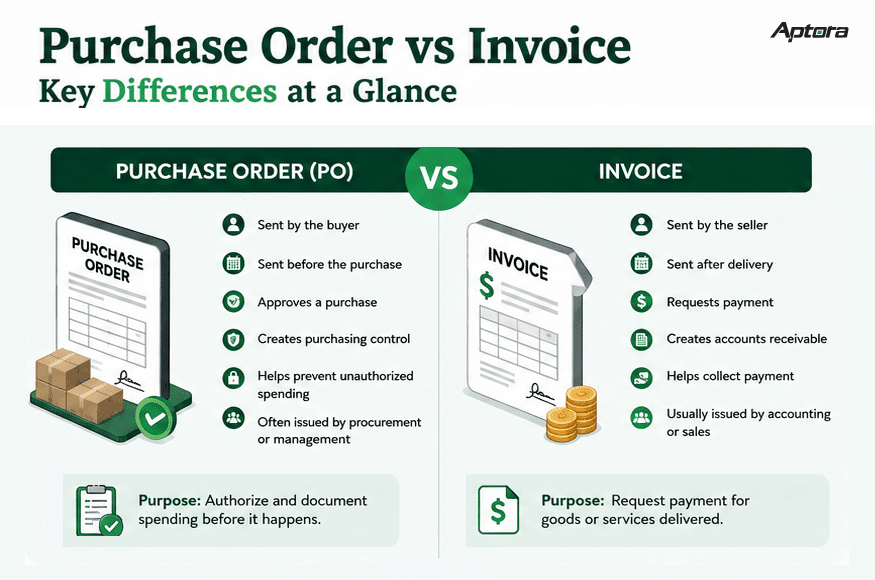
A lot of accounting confusion comes from treating purchase orders and invoices like interchangeable paperwork. They’re not. The key differences come down to timing and purpose.
| Purchase Order | Invoice |
| Sent by the buyer | Sent by the seller |
| Sent before the purchase | Sent after delivery |
| Approves a purchase | Requests payment |
| Creates purchasing control | Creates accounts receivable |
| Helps prevent unauthorized spending | Helps collect payment |
| Often issued by procurement or management | Usually issued by accounting or sales |
A purchase order starts the transaction and an invoice finishes it.
That sounds simple enough, but in practice, many small businesses blur the lines between the two, especially in the early stages when purchasing is informal and everyone “just texts the vendor.”
That works until it doesn’t.
I’ve seen businesses discover weeks later that someone ordered materials without approval, changed pricing mid-project, or submitted invoices for work nobody remembered authorizing. In nearly every case, the root problem was the same: there was no formal purchasing process before the invoice showed up.
That’s exactly why purchase orders exist.
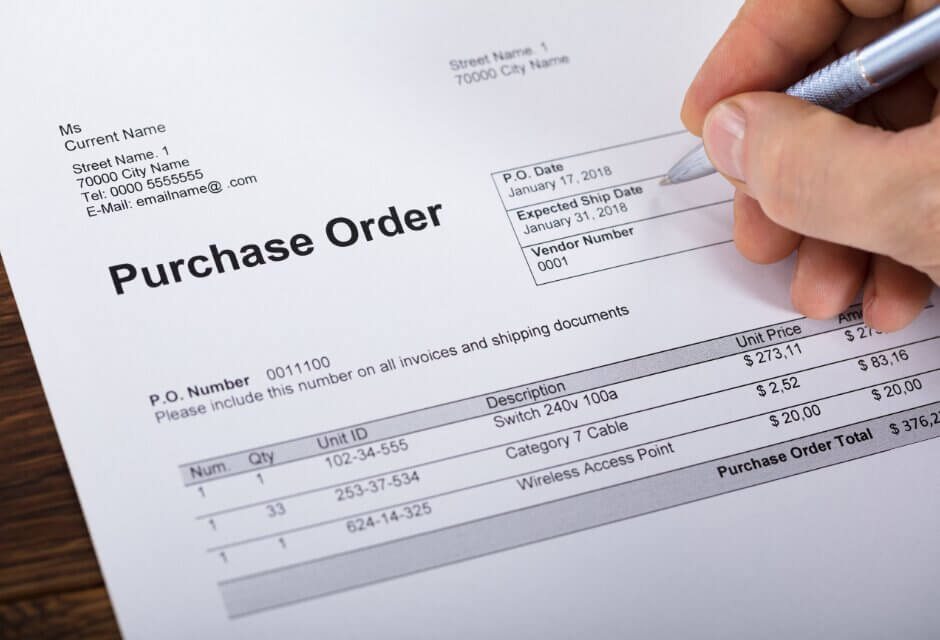
A purchase order is a formal document a buyer sends to a vendor before the vendor delivers goods or services.
It outlines:
Once accepted by the vendor, a purchase order becomes a binding commercial agreement.
For small businesses, a PO acts as a control mechanism. Instead of discovering expenses after the fact, owners can approve spending before they make commitments.
Imagine a landscaping company ordering irrigation supplies for a new commercial project.
Before the supplier ships anything, the company issues a purchase order listing:
The supplier reviews the PO, accepts it, and ships the materials.
At that point, everyone knows exactly what was approved.
💡 Pro Tip: If your business regularly buys materials, inventory, equipment, or subcontractor services, it’s time to implement a formal purchase order process. Purchase orders help reduce billing disputes, improve spending visibility, and prevent costly surprises before they hit your bottom line.
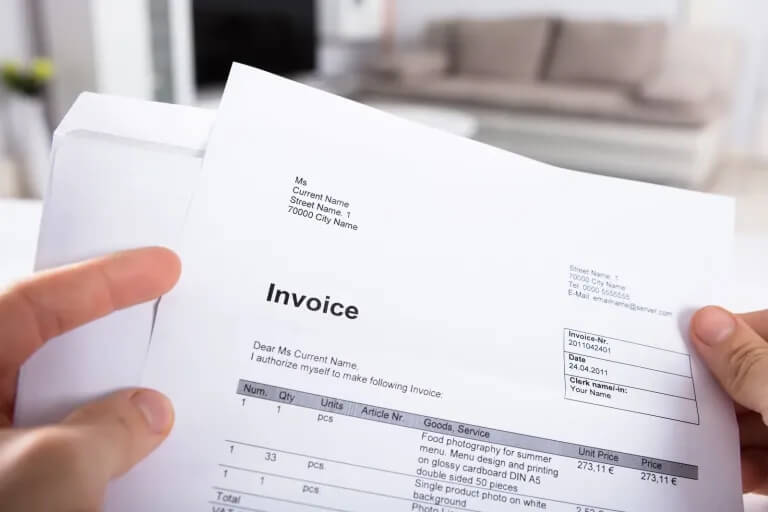
An invoice is a payment request the seller sends after delivering goods or services.
Invoices typically include:
Unlike purchase orders, invoices directly impact accounting records because they represent money owed.
For the seller, the invoice creates accounts receivable.
For the buyer, it creates accounts payable.
Using the same landscaping example, after the irrigation supplier delivers the materials, they send an invoice requesting payment for the approved order.
The invoice references:
The buyer then verifies the invoice against the original purchase order before paying it.
Some small business owners assume purchase orders are “big company paperwork.”
Though, in reality, they solve problems businesses of every size run into.
A purchase order answers the important questions upfront:
Without a PO, businesses often rely on memory, text messages, or verbal conversations which is super risky.
I once worked with a contractor who said, an invoice “looked fine, so we paid it.” Later, realizing the material quantity billed was almost double what the project required. Nobody caught it because there was no approved purchase order to compare against.
That one little oversight erased most of that project’s profit.
This is why purchase orders matter so much. They create a clear, documented checkpoint before businesses commit money, helping them catch pricing mistakes, quantity discrepancies, and unauthorized purchases before these issues turn into expensive problems.
Invoices, on the other hand, formalize the payment side of the transaction.
They help businesses:
Without invoices, accounting becomes nearly impossible to manage accurately.
Purchase orders and invoices are not competing documents.
They are two parts of the same purchasing and payment workflow.
Here’s the typical process:
This verification process is often called two-way matching or three-way matching in accounting.
💡 Pro Tip: Require your vendors to include the PO number on invoices. This will make reconciliation dramatically easier and reduce the likelihood of duplicate payments.
Not every small business needs a highly formal procurement department.
But, most businesses can benefit from purchase orders far earlier than owners expect.
If your business:
…a PO system can create immediate operational improvements.
Even a basic spreadsheet-based process is better than nothing at all.
The moment multiple people can spend company money, purchasing control becomes pivotal.
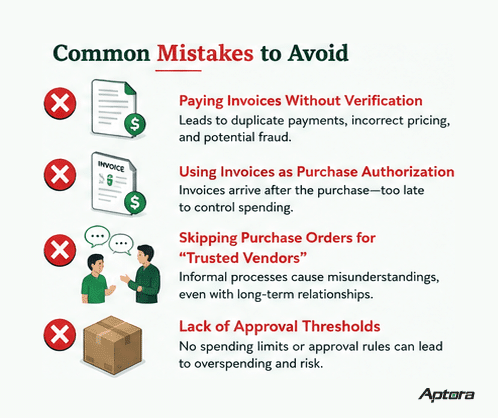
This is one of the most common accounting mistakes.
Without comparing invoices to approved purchases, businesses risk:
An invoice is NOT approval.
By the time the invoice arrives, the money has effectively already been committed.
That’s why relying solely on invoices creates reactive spending instead of controlled spending.
Ironically, long-term vendor relationships are where informal processes often become the sloppiest.
People stop documenting approvals because “we’ve worked together forever.”
That’s usually when misunderstandings begin.
Not necessarily because anyone is dishonest, but because memory is unreliable and projects change quickly.
💡 Pro Tip: Set dollar thresholds for purchase order approvals. For example, require manager approval for purchases over $500 and owner approval for purchases over $5,000. This keeps routine purchases moving quickly while adding extra oversight to larger expenses that carry more financial risk.
Purchase orders and invoices are two sides of the same transaction. A purchase order creates approval and clarity before the purchase happens, while an invoice documents what is owed after goods or services are delivered.
For small businesses, understanding the difference is more than just learning accounting terminology. It is part of building better financial controls, improving visibility into company spending, reducing disputes, and protecting already tight profit margins.
In many cases, implementing even a simple purchase order process is one of those deceptively small operational upgrades that quietly makes your entire business run better. Expenses become easier to track, approvals become clearer, vendor communication improves, and fewer costly mistakes slip through the cracks. As your business grows, those improvements compound into healthier margins and smoother operations.
If an invoice contains different pricing, quantities, or terms than the original purchase order, the discrepancy should be reviewed before payment is approved. Businesses typically contact the vendor to correct the invoice or confirm whether changes were authorized.
Yes. Businesses can revise purchase orders when quantities, pricing, delivery dates, or project needs change. These revisions are often called change orders or amended purchase orders and should be documented clearly to avoid confusion later.
While requirements vary by jurisdiction, invoices are commonly required for bookkeeping and tax documentation. Purchase orders are not always legally required, but they can provide valuable supporting records during audits or financial reviews.
Many accounting platforms and ERP systems include PO software, including Aptora, QuickBooks, and Xero. Some small businesses also manage purchase orders using spreadsheets before moving to dedicated software.
Yes, especially for recurring purchases with consistent vendors or pricing agreements. Using purchase orders for repeat purchases creates better tracking, clearer approval records, and more predictable budgeting over time.

The Vendor Types List is used to manage and classify the various suppliers (vendors) from which you buy goods and services. Examples of vendor types
What is Unit of Measure (UOM)? Often companies purchase an item and sell that item in smaller portions. You might purchase a 20-foot piece of
Warranty Reserve Accounting A warranty reserve helps cover anticipated but unpredictable expenses. The concept applies to system replacements and other types of sales. It also
A subtotal is the sum of a group of amounts before you calculate the final total. On an invoice, a subtotal adds several item amounts