Vendor Types List: Which Categories Fit Your Suppliers?

The Vendor Types List is used to manage and classify the various suppliers (vendors) from which you buy goods and services. Examples of vendor types


The simplest answer is: supplies can be both an asset or an expense, depending on when you account for them. Under accrual accounting, businesses generally record material supplies they purchase but have not yet used as a current asset. As your business consumes those supplies, their cost becomes an expense.
That distinction is easy to understand once you see how the money moves through your books. Let’s walk through it without making accounting more complicated than it needs to be.
📥Want a practical way to put these accounting principles into practice? Download our FREE Supplies & Materials Accounting Checklist to help you classify purchases, track supplies on hand, and complete your month-end review.
Yes. Under accrual accounting, unused supplies can be an asset because your company owns something of value that it expects to use in the future.
Suppose you purchase $2,000 worth of shop and office supplies and still have $1,200 sitting on the shelves at month-end.
If that amount is material to your financial statements, the $1,200 represents supplies on hand and can remain in a Supplies asset account.
The basic rule is:
Unused supplies = asset
Supplies consumed = expense
I have spent years working with contractors and teaching materials and inventory management. One thing I emphasize is that good accounting should tell you what you actually have and what it actually costs you. Throwing everything into an expense account may be easy, but easy and useful are not always the same thing.
If you’re wondering, “Are supplies a current asset?”, the answer is generally yes when your company expects to use them within its normal operating cycle or within one year. In contrast, equipment generally qualifies as a long-term asset because your business expects to benefit from it for more than one year. For a closer look at how equipment is classified, checkout Is Equipment a Current Asset?
Supplies on hand normally appear in the current assets section of the balance sheet alongside accounts such as:
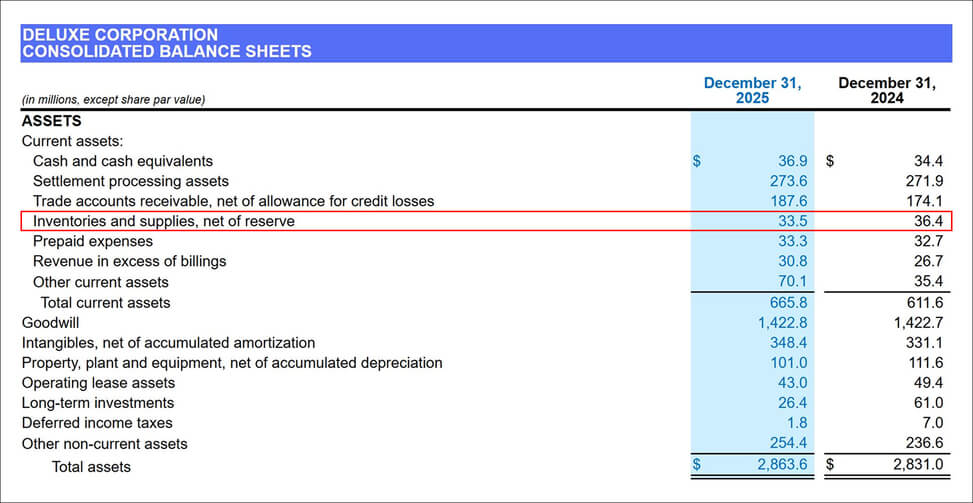
It’s important not to confuse “current asset” with something that can necessarily be turned into cash easily. A box of printer toner may qualify as a current asset because you expect to consume it soon, not because you plan to sell it.
You do not need to inventory every pen, rag, or roll of tape in your building.
Accounting recognizes materiality, which means you don’t need to use more complex accounting methods for an item if doing so would not make a meaningful difference to your financial statements.
There is no universal rule saying that supplies become material at exactly 5% of assets; the SEC actually cautions against relying exclusively on numerical thresholds when evaluating materiality, as explained in SEC Staff Accounting Bulletin No. 99, Materiality.
💡 Pro Tip: Establish a reasonable and consistent accounting policy with your accountant. Once you decide how to handle an item, apply that approach consistently from period to period rather than changing it to make your financial results look better in a particular year. Consistency makes your financial statements more reliable and easier to compare over time.
Yes, but generally after your business uses them, or immediately if your company’s accounting policy treats the amount as immaterial.
For example, suppose you begin the month with $1,000 of supplies and have $300 remaining at month-end. That means your business used $700 during the month, so you record $700 as Supplies Expense, while the remaining $300 stays on the balance sheet as an asset.
The key distinction is that purchasing supplies creates an asset, while using those supplies turns that asset into an expense.
People often ask, “Do supplies go on the income statement?” The portion used during the accounting period generally does.
The distinction looks like this:
| Supplies Status | Financial Statement | Classification |
| Unused and material | Balance sheet | Current asset |
| Used or consumed | Income statement | Expense |
| Immaterial and expensed when purchased | Income statement | Expense |
This keeps your income statement from reporting the full cost of a significant supply purchase before the business actually consumes those resources.
An example of supplies might include printer paper, toner, labels, pens, cleaning products, disposable gloves, shop towels, or other consumables used to operate the business.
For a construction or service company, however, classification gets more important. There is a difference between operating supplies and materials purchased for jobs.
For example:
This is where I see contractors get into trouble with their numbers: everything purchased at the supply house gets treated as though it were the same kind of cost. It isn’t. If you want meaningful job costing and gross profit numbers, your chart of accounts and item classifications need to reflect what actually happened.
💡 Pro Tip: Be sure to separate operating supplies, inventory, direct job materials, and equipment. Each category gives you different information about how the business is spending money, managing costs, and generating revenue, and should be accounted for differently.
The easiest way to understand supplies accounting is to follow the transaction from purchase to use. Suppose your company purchases $1,500 of supplies on account. You initially record the full $1,500 as a Supplies asset, because you still have those supplies on hand.
Account                     | Debit ($) | Credit ($)
----------------------------|-----------|------------
Supplies                    | 1,500     |
Accounts Payable            |           | 1,500
At the end of the month, you count the supplies and find that $500 remains. That means $1,000 was used during the month, so you move that $1,000 from the Supplies asset account to Supplies Expense.
Account                     | Debit ($) | Credit ($)
----------------------------|-----------|------------
Supplies Expense            | 1,000     |
Supplies                    |           | 1,000
Your balance sheet now shows $500 of supplies on hand, while your income statement reports $1,000 of supplies expense.
That is really the entire concept: move the cost from the asset account to the expense account as the economic benefit is consumed.
Supplies help you operate the business. Inventory generally consists of items held for sale or certain materials that become part of what you sell.
That distinction can become especially important in construction, HVAC, plumbing, electrical, and other field service businesses where trucks and warehouses may contain both operating supplies and sellable parts.
Tax accounting adds another layer. The IRS has specific rules for materials and supplies, along with special inventory rules for qualifying small businesses, so the way you handle supplies for tax purposes may differ from the simplified financial-accounting examples above. IRS Publication 538, Accounting Periods and Methods explains these rules in more detail.
When it comes to your actual tax reporting, it’s worth working with a qualified tax professional who understands your accounting method, your business, and the rules that apply to your specific situation.
A spreadsheet can track supplies, expenses, inventory, purchase costs, job materials, quantities, adjustments, and job costing, right up until someone forgets to update a cell, overwrites a formula, or creates another version named Inventory-FINAL-v7.xlsx.
I’ve worked with contracting businesses long enough to know that the problem usually isn’t a lack of spreadsheets. It is having important information scattered across systems that don’t communicate with one other.
That is why integrated construction software matters.
Aptora’s construction management software brings accounting, purchasing, inventory, job costing, reporting, and operational information together in one unified system. So, instead of maintaining another spreadsheet to determine what you bought, what you used, and where it went, your accounting records can become part of the same workflow your company already uses to run jobs.
If keeping your spreadsheets updated is becoming a job in itself, it may be time for a better system.
The right frequency depends on your business and how much supplies fluctuate, but many businesses benefit from a regular monthly or quarterly count. A consistent schedule helps you catch discrepancies and keep your financial records accurate.
You’ll need to investigate the difference and determine whether it came from usage, waste, damage, theft, or an accounting error. Once you identify the cause, make the appropriate adjustment so your books reflect what you actually have on hand.
Not necessarily. Operating supplies generally don’t need to be assigned to individual jobs, but materials that become part of a specific job should typically be tracked separately so you can accurately measure job costs and profitability.
If supplies can no longer provide value to the business, their carrying value may need to be written off rather than left in the Supplies asset account. The appropriate treatment depends on why the supplies became unusable and your accounting policy.
Yes. Financial accounting and tax accounting can have different rules for when materials and supplies are recognized as expenses. Your tax treatment should follow the rules that apply to your accounting method and business, so it’s worth discussing the specifics with your tax professional.
Use a system that lets you track purchases, quantities, transfers, usage, and adjustments by location or vehicle. This gives you better visibility into where supplies are going and makes it easier to reconcile what your records show with what you actually have.

The Vendor Types List is used to manage and classify the various suppliers (vendors) from which you buy goods and services. Examples of vendor types
What is Unit of Measure (UOM)? Often companies purchase an item and sell that item in smaller portions. You might purchase a 20-foot piece of
Warranty Reserve Accounting A warranty reserve helps cover anticipated but unpredictable expenses. The concept applies to system replacements and other types of sales. It also
A subtotal is the sum of a group of amounts before you calculate the final total. On an invoice, a subtotal adds several item amounts